
Already in 1965 there was no time for it. And yet, several decades and hundreds of songs later, we’re doing it more than ever.
The phrase “fussing and fighting” (and variations thereon) crops up in at least 1,368 recorded songs from the last 100 years. No wonder: It’s an alliterative pairing with lots of rhyming options, and it captures several ideas of conflict. It makes sense lyricists would recycle it across the generations.
Perhaps the best-known example of a fuss/fight lyric is in the Beatles’ “We Can Work it Out,” where it is all the more memorable because it comes at an inflection point where the song shifts from common time to waltz time: “Life is very short, and there’s no time / For fussing and fighting, my friend.”
The Beatles’ influence on popular music cannot be overstated, and unsurprisingly “We Can Work it Out” has generated at least 134 English-language covers, according to SecondHandSongs.com. And while “fussing and fighting” certainly did not originate with the Beatles, they may have been a catalyst for its future use.

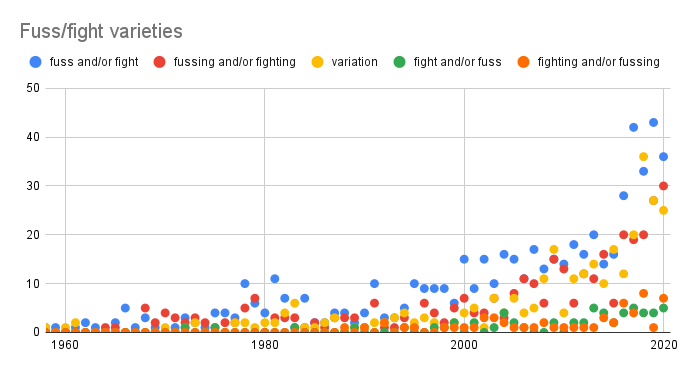
Until 1958, fuss/fight appeared in song less than once a year, according to my survey of entries on the lyrics website Genius.com and elsewhere. Afterward, it began a steady climb in frequency. In the ’70s, fuss/fight appeared in an average of seven songs a year. In the ’80s the average was nine, and in the ’90s it was 13. In the 2000s it ballooned to an average of almost 30 instances per year. That average more than doubled in the 2010s. It appeared in 104 songs from 2020 alone.1
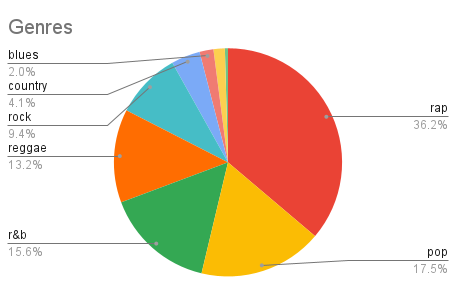
I should note at the outset that this study makes no distinction between major-label acts and the smallest independent productions. Both coexist on Genius and, more to the point, both reflect how the pairing is used in general, not just in music. On a related note, I’d don’t pay much attention here to genres. Fuss/fight turns up in all of them.

The earliest instance of a fuss/fight lyric that I have found is from 1909, in a printed University of Washington football fight song that carries the alliteration to the extreme.2 As far as recorded music goes, fuss/fight’s earliest instance (at least according to Genius) is in Gertrude “Ma” Rainey’s “Yonder Come the Blues” from 1926:
I worry all day, I worry all night
Every time my man comes home, he wants to fuss and fight
When I pick up the paper to read the news
Just as I’m satisfied, yonder come the blues
Here are the two major senses in which “fussing and fighting” will be used until the present day. First Rainey bemoans a tumultuous romantic relationship. Then, if we may extend the metaphor, she is distressed by reading the news about the fussing and fighting going on around the world. Fuss/fight songs describing various kinds of social strife are numerous, but not nearly as plentiful as fuss/fight songs describing everyday disagreements between two people.
For the birds
Fuss/fight, and its association with rocky romances, was part of American and British English well before Ma Rainey. In one example, the narrator of a comic poem printed in London in 1861 expresses his desire for a wife “Who’ll not think a mile of walking / A cause for fight or fuss, / And even on emergency / Will travel by a ’bus.”3 A novel printed in New York in 1883 used the pairing this way: “All the lawyers have been trying to make friends with the old general and his wife for seven years, so as to get a job on divorce papers, as no one believed that they could keep together much longer and fight and fuss the way they did.”4
In modern song, the artist who uses fuss/fight most frequently is 2021 Rock & Roll Hall of Fame nominee Mary J. Blige. The pairing appears in six of her songs from 1995 to 2009. In four of them she urges her lover to set aside their differences, either for the evening or indefinitely. For example, in “Mary Jane (All Night Long)”, she sings: “Ooh baby, not tonight / I don’t wanna fuss and fight / I just wanna make it right.” In “Searching” she relates a fraught relationship to social strife, and in “Christmas in New York” she uses “fuss and fight” to describe the jockeying of taxi drivers.
Behind the ubiquitous “night,” the most frequent rhyme appearing in fuss/fight songs is “right,” often in the context of a plea for reconciliation. In “That’s Why I Wanna Fight,” four-time fuss/fight user Mýa sings: “We gotta make up tonight / That’s why I wanna fight with you / Break the rules / So we can get it right / And I’ll show you how I do / I wanna fuss and fight / Then make it up tonight.”
Country rocker Koe Wetzel has one of the handful of the songs with fuss/fight in the title. In it he sings: “Girl, you know that I love you / And you know that I care / But babydoll, this fussing and fighting’s for the birds.”
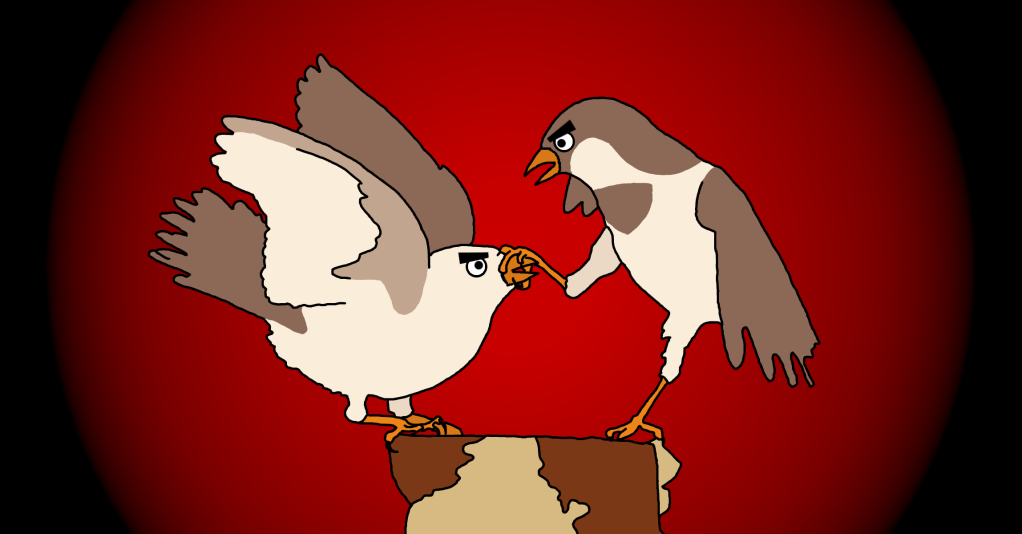
(Wetzel is also one of only two lyricists to associate fuss/fight with birds. The pairing was more frequently applied to birds — particularly English sparrows — in printed text of the late nineteenth century and onward. As one magazine writer observed in 1908, “They never seem to accomplish anything, just chattering here and there, bobbing around here and there, fighting and fussing, the meanest, nastiest little birds in the world.”5)
In some relationship songs, narrators put their feet down. Alana Bridgewater, in “Do It By Yourself,” has had enough: “Every time you’re around, we always fuss and fight / You’ve had three years to get this thing right / With your dumb ass.” Hurricane Chris doubles up the phrase in “Leaving You”: “But all you do is fuss and fight like you just don’t know how to act / I’m sick and tired of hollerin’ and fussin’ and fightin’.”
Ebony Eyes sidesteps relationship pitfalls and espouses self-love in “Good Vibrations,” rapping: “See I don’t fuss and fight, if he ain’t acting right, I just tell him (say hello to my little friend).” And in “Vices,” Ludacris expresses his preference for liquor over romantic entanglements: “The only loyal bitch I know’s a loyal bitch named Tanqueray / She gets me right every time, it ain’t never no fussing or fighting.”

The vast majority of relationship songs are narrated by one of the people engaged in the fussing and fighting. Occasionally these narrators describe “haters,” outsiders who see the fussing and fighting and disapprove or even urge an end to the relationship. Only rarely is the fussing and fighting described by one of these outsiders, as in “Couple Next Door” by Afroman and “Johnny Dollar” by Roland Burrell. Meanwhile Barbara Pennington sees the object of her affection endure one failed relationship after another while remaining only his “Trusted Friend.”
Sometimes the male narrator criticizes his partner for fussing and fighting, which sometimes involves making a scene, as in “Don’t Give Up on Me” by Keith Phelps: “’Cause we fighting and we fussin’ / We arguin’ and we screamin’ / Seem like every time that I’m with you / It’s like an episode of Jerry Springer.”
Narrators, usually male ones, often see this bickering as an obstacle, or sometimes prelude, to sex, as in “Without You” by HrtBrkJay: “You say I don’t love you right, all we do is fuss and fight / I just wanna get back to the days we used to fuck at night.”
Rap is sometimes singled out for misogynistic lyrics, but it certainly doesn’t have a monopoly. For example, country singer George Jones objectifies women in “I’d Rather Switch than Fight”: “Now my first wife was a lovely sight to view / But fuss and fight was all she cared to do / When she reached forty-four, well, I shoved her out the door / And I got me a couple that were twenty-two.”
Occasionally the fussing and fighting will tip into the realm of domestic violence, whether executed or threatened. Tarrus Riley sings in “Start a New”: “You know it’s not right, whole heap of fuss and fight / Him waan thump you inna yuh eye mum […] It’s not right, cho, whole heap of fuss and fight / Inna di most high sight / And there’s nothing domestic about it.”
Rarer than songs about romance are songs about familial love. See “My Uso” by STNDRD and “Brotherly Love” by Billy Dean for sibling rivalries, and Big Scoob’s “Brand New Day” about fleeting arguments between father and daughter.
Even rarer are songs about friendships occasionally beset by disagreement. “Ace Boon Coon” by Shanice is one example: “My ace boon coon tells me when I’m wrong / We fuss and fight but it doesn’t last for long.”
Not a good policy
In song as in everyday conversation, fuss/fight can also be used to describe broader discord, often in a racial context.
Some of the pairing’s earliest examples on Google Books come from Congressional testimony around political violence in the Deep South at the end of Reconstruction. In 1877, David Todd, a white lawyer and Democratic Party canvasser, described a tense gathering before the previous year’s election in his majority-Black parish of Louisiana:
It was after this fussing and fighting was stopped and the people were advised that no man should be intimidated; that every colored voter should cast his vote for any man he wanted to; that there was no necessity of intimidation, because the colored people had come over to us nearly unanimously.6
Elsewhere in his testimony Todd said, “I never heard of any bull-dozers in our parish,” referring not to heavy equipment but rather those who tried to intimidate (Republican-leaning) Black voters. The expression derived from White plantation overseers flogging enslaved Blacks, and later White vigilantes flogging freed Blacks, with a bullwhip — giving them a “dose of the bull.” This practice inspired “Bull Doze Blues” by Henry Thomas, recorded in 1928, which describes fleeing Mobile, Alabama, and going “where I never get bulldozed,” Memphis, Tennessee.8
Fuss/fight did not appear in Thomas’s lyrics. But it was there four decades later when Canned Heat appropriated the song under the title “Going Up the Country”: “I’m gonna leave this city, got to get away / All this fussing and fighting, man, you know I sure can’t stay.” This white group was not singing about fleeing racist violence, but rather escaping the rat race.
Song narrators often express hopes for transcending fussing and fighting, whether in the form of epochal political conflict or the workaday world. This would seem a natural topic for hippie-era music, but Canned Heat is the only Woodstock-associated act to use the pairing. However, a Motown-flavored 1969 release by the Anonymous Children of America packs some granola crunch: “It could be such a beautiful world / For every man, woman, boy, and girl / If we would stop fussing and fighting each other / We need to get together like sisters and brothers / What we really need now is love and peace, today.”
Songs calling for social unity are primarily the domain of reggae and other music connected to Jamaica, where the appeal is often couched in Rastafarian religious terms. Here fussing and fighting is another symptom of Babylon’s insidious influence.
In another of the songs taking its title from our alliterative pairing, Bob Marley asks, “Why’s this fussing and a-fighting? / I want to know, Lord, I want to know.” Junior Reid in “One Blood” puts social strife in a family context: “The fussing and fighting tribal war racial war / Cause blood blood / Mothers fighting daughters everyday / Fathers fighting sons / Sisters hating sisters brothers killing brothers everyday.”
Inasmuch as fuss/fight lyrics offer social critiques, they warrant social critique themselves. A number subscribe to what Ibram X. Kendi calls the oppression-inferiority thesis, which holds that Black people as a race have been “imbruted” by the experience of slavery and/or subsequent injustices.
One example is the Abyssinians’ “Declaration of Rights”: “Took us away from civilization / Brought us to slave in this big plantation / Fussing and fighting, among ourselves / Nothing to achieve this way, it’s worse here than hell, I say.”
Another is the Capital Letters’ “Out of Africa”:
Out of Africa they took us
And they sold us as slaves for money
Who they could not sell
Dem kill dem, kill dem, kill dem
Now these things are changing
Black people killing Black people
Some a dem a use guns
Some a dem a use knifes
But most of all the rest a dem a use dem mouth
Dem mouth
Black people we will never learn
We’ve got to stop this fussing and fighting
Stop this cheating and backbiting
Generalizations like these are problematic, as Kendi writes: “[T]here is a thin line between an antiracist saying individual Blacks have suffered trauma and a racist saying Blacks are a traumatized people. There is similarly a thin line between an antiracist saying slavery was debilitating and a racist saying Blacks are a debilitated people.”9
A few fuss/fight songs feature Black vocalists calling on fellow Black people to improve their behavior — to renounce fussing and fighting — for the good of their race. In the 1989 celebrity megasingle “Self Destruction,” Heavy D raps:
Ayo here’s the situation: idioicy [sic]
Nonsense, violence, not a good policy
Therefore we must ignore, fighting and fussing
Heavy’s at the door so there’ll be no bum-rushing
Let’s get together or we’ll be falling apart
I heard a brother shot another, it broke my heart
I don’t understand the difficulty, people
Love your brother, treat him as an equal
They call us animals, uh-uh, I don’t agree with them
I’ll prove them wrong, but right is what you’re proving them
This is a striking example of what Kendi identifies as “uplift suasion,” an idea dating from before the end of slavery that calls on Black individuals to demonstrate upstanding behavior so as to persuade away the racist ideas of Whites. But as Kendi points out, uplift suasion is not only ineffective, it’s also racist. Believers in uplift suasion, Kendi writes, “strap the entire Black race on the Black body’s back, shove the burdened Black body into White spaces, order the burdened Black body to always act in an upstanding manner to persuade away White racism, and punish poor Black conduct with sentences of shame for reinforcing racism, for bringing the race down.”10
White performers do occasionally address racial strife. One Mose Allison song envisions a postracial, postapocalyptic utopia: “Ever since the world ended / There’s no more black or white / Ever since we all got blended / There’s no more reason to fuss and fight / Dogmas that you once defended / No longer seem worthwhile / Ever since the world ended / I face the future with a smile.”
XTC’s “King for a Day” decries greed, and its bridge harks back to the Beatles’ sense of urgency: “You’re only here once, so you gotta get it right / (No time to fuss and fight) / ’Cause life don’t mean much if measured out with someone else’s plight / (In time you’ll see the light).”
A handful of other fuss/fight songs point to economic inequality, like Clinton Fearon’s “I’ll Be Around”: “If life was a thing that money could buy / The rich would live and the poor would die / We don’t have to fuss, we don’t have to fight / Just share up the pie and do what is right.”
Is fuss/fight a cliché? The writers of “Ras Trent” seem to think so. The Lonely Island parody song concludes with a litany of reggae terms and one of Jamaica’s top exports: “Fussing and fighting and Zion and roots / Red Stripe, Shabba, ragamuffin and culture.” But of all the songs on the reggae-focused Jah-Lyrics.com, only about 140 songs involve fuss/fight. The site returns only 13 lyric results for “ragamuffin.”
Cliché or not, fuss/fight is old enough and recognizable enough to be picked up and used with no discernible meaning. Some 28 songs in the dataset remain uncategorized, as I was unable to divine from the lyrics any concrete interpretation. For example, this Snoop Dogg verse from “There is Only Now” by Souls of Mischief seems interested only in the rhymes, the sounds of the words: “Can you imagine being told, by the old / This ain’t right, fuss and fight / Don’t you roll, it’s so cold / What’s your mold, will he break or will he fold?”
Wang dang doodle
Fuss/fight has long been invoked to describe disorderly conduct, appearing in court testimony at least as early as 1876. This sense is reflected in one of the most-covered fuss/fight songs, originating in 1954 with Willie Dixon: “We gonna romp and tromp till midnight / We gonna fuss and fight till daylight / We gonna pitch a wang dang doodle all night long.”
Delta blues pioneer Charley Patton had the same idea, singing on a 1930 recording: “I love to fuss and fight / Lord, I get sloppy drunk off a bottle ’n bond and walk the streets all night.”
And at least two adaptations of a 1949 blues paean to carousing use fuss/fight. Champion Jack Dupree sang in 1962: “Drinkin’ that wine and staying alive / When they get drunk, they want to fuss and fight.” Or as Hank Williams III put it in 2001: “Drinkin’ that mess is sure delight / Soon to be fightin’ and fussin’ all night.”
Physical violence is rare in the fuss/fight songs, but the rowdiness does occasionally verge on brawling. English rapper Wiley’s “123 Go” features this menacing verse from Shifty: “Wait, I’m not one for fussing or fighting / But if it goes off I will butt him and bite him / Hook him like Tyson, I will uppercut him and strike him / Treat him like butter, knife him.”
Other songs reject such ruffianism, as well as relationship drama, with the narrators describing their own equanimity. This state is sometimes chemically induced, as in Conkarah’s “Ganja Field,” as well as in Juice WRLD’s “Big Swag”: “Sick of niggas, starting taking Robitussin, yeah! / Ain’t with fighting, ain’t with fussin’, ain’t with tussling, yeah!”
In some lyrics the fussing and fighting is personal, ranging from emotional anguish, mental illness, and addiction all the way down to life’s little setbacks. Faith Evans sings on “Do My Thang”: “Don’t wanna argue, fuss and fight / No, that’s okay / I’m tryna hit the floor and dance my blues away.” On the flip side, fuss/fight can be a positive thing, standing in Georgia Anne Muldrow’s “Kneecap Jelly” for assertiveness: “Digging deeper for a change that I could trust forever / And to get by I will try to fight and fuss more clever.”
One sense of fuss/fight present in historical texts but altogether absent from modern song: political activism. For example, a speaker at the 1916 convention of the Atlantic Deeper Waterways Association exhorted the audience to “keep fighting and fussing at your Congressmen and Senators.”11 (No doubt there exists outside the record a protest song to prove this assertion wrong.)
There’s also little to be found in fuss/fight songs about geopolitics, although the pairing has been used in that context at least as early as an allegorical poem from 1891 about England and France quarreling over the Canadian Atlantic fishery. France is depicted as a lobster clutching the tail of a Newfoundland dog. “How came it about? That’s a matter of doubt, / Which there isn’t much use in discussing, / To part them’s my aim; I would manage that same / Without either fighting or fussing.”12 The magazine printed the anonymous poem alongside this illustration by John Tenniel, famous to this day for his illustrations in Lewis Carroll’s “Alice” books.

Lexicographical considerations
Fuss/fight is most prevalent in music in its most basic form. “Fuss and/or fight” is used 593 times. Its reverse, “fight and/or fuss” appears the least often, with only 59 instances. There’s a similar relationship between “fussing and/or fighting” (350) and “fighting and/or fussing” (65). Two artists (Barosky in Ofori Amponsah’s “Otoolge” and Moneybagg Yo in “Back N Forward”) deploy the poetic device known as chiasmus and have it both ways.
Deviations from the verb-conjunction-verb form number 310. “We fuss and we fight” is a common example.
Fussing and fighting in many instances would seem to mean about the same thing as arguing. But several songs nonetheless place all three words side by side, as in the frequently covered “If You Don’t Know Me By Now” by Harold Melvin and the Blue Notes: “Don’t get so excited when I come home a little late at night / ’Cause we only act like children when we argue, fuss and fight.” Argue/argument shows up in 90 of the fuss/fight songs. Such piling on could be used to reinforce the argumentative connotation or simply fit the meter of the lyrics. Or it might suggest each word has a subtly different meaning.
“Cuss,” evocative of heated argument and an easy rhyme for “fuss,” shows up in 89 of the songs. (Genius returns about 130 results for fight/cuss variants and about 150 fuss/cuss variants, with many overlapping.)
While songwriters seem to like the F sounds of fuss/fight, further alliteration is exceedingly rare. “Feud” accompanies the pair twice, “fret” only once. Fuss/fight’s cousin fret/fume is practically nonexistent in lyrics results on Genius.
Fuss/fight may be the most prevalent alliterative pairing in song, but it is not the only one. Toss/turn shows up about 2,000 songs on Genius, many of which are duplicates — covers of Bobby Lewis’ soul hit from 1961 as well as “Tainted Love,” another soul tune that found a bigger audience in 1981 when it was covered by Soft Cell.
Genius turns up about 1,000 results each for two other pairings, method/madness and rhyme/reason. But many of the results are not song lyrics: They’re the text of classic books, historical speeches and other documents likely to be searched by college students. Few such nonmusic results come up for fuss/fight.

Method to my madness
Most examples in this essay and the accompanying dataset come from searches of “fuss and fight” and “fussing and fighting” at Genius.com. The grand total of 1,368 songs is based on original versions only, with covers excluded from the count but noted in the spreadsheet.
Genius’s search engine is fairly sophisticated, returning relevant variations on the phrases, including “fuss(ing) or fight(ing),” lyrics with ampersands, omitted Gs at the end of the gerunds, and distortions such as “fust” and “fusing.”
Most lyric results that clearly link fuss(ing) and fight(ing), including on adjacent lines, were included. Excluded were a handful of “dead songs.” These are defined as songs with lyrics results on Genius and other lyrics websites that are unavailable on YouTube, Spotify, or other online places where the song could actually be heard.
Marginal results, which included fuss(ing) and fight(ing) in close proximity but did not implicitly connect them, were excluded. One example is Felicia Temple’s “Make Up Sex”: “So here we go again with all this arguing / I don’t know what we’re fighting for / All this screaming, fussing, yelling, cussing / I swear it only makes me want you more.”
One big question remains unanswered: How good a research tool is Genius? Very few published scholars appear to have availed themselves of it. In its pages I have encountered (and attempted to correct) a large number of lyrical inaccuracies, spelling errors and other problems. Most of Genius’ content is crowdsourced, which means its quality is not always top notch. On the other hand, I never could have hoped to find so many fuss/fight examples without it.
But that raises yet another question: How comprehensive is Genius? I have not been able to find a reliable estimate for how many songs are represented on the website. Whatever the number, it must grow by dozens or hundreds every day. Nor is there any information on what proportion of all popular vocal music Genius is likely to reflect. That may well be an unanswerable question, especially considering the proliferation of independent music of all genres in the last few decades. Anecdotally I can report that I never have I been unable to find desired lyrics on the website. On the other hand, additional searches for this study on Jah-Lyrics.com yielded 75 pertinent results, all from reggae, that were not on Genius.
It also should be pointed out Genius’ genre classification are just as haphazard as its transcriptions. I made some efforts to increase the accuracy of genre classification for songs included here, but errors and arguable decisions are still likely to be found. For the purposes of this study, I separated songs into nine genres: blues (which here includes a handful of jazz tunes), country, musical, pop (very loosely defined), R&B (in the modern sense), rap, reggae (including other music originating in the Caribbean generally, or modeled after it), rock, and soul (including Motown).
Notes
- Fuss/fight’s usage follows a similar curve in published text but appears to have experienced a sharp dropoff after 2011. See this Google Ngram Viewer visualization.
- Hoover, Glen. “The Game Song” in “The Washington Song-Book.” Published by the Associated Students of the University of Washington, 1909, Menasha, Wis.: George Banta Publishing Co., p. 87. Online, https://www.google.com/books/edition/The_Washington_Song_book/OBlC0ru1QOcC. Accessed 5 May 2021.
- “The Song of the Younger Son,” in “Punch, or the London Charivari,” 16 Nov. 1861, p. 193. Online, https://www.google.com/books/edition/Punch/QlFIAQAAMAAJ. Accessed 2 May 2021.
- Philkins, Ike. “The Science of Love.” In “Chained Lightning,” New York: J.S. Ogilvie & Co., 1883, p. 30. Online, https://www.google.com/books/edition/Chained_Lightning_a_Book_of_Fun/WpcVAAAAYAAJ. Accessed 2 May 2021.
- Kenyon, J.D. “The Science of Successful Salesmanship.” In “Hardware,” 25 July 1908, p. 33. Online: https://books.google.com/books?id=9Jc7AQAAMAAJ. Accessed 21 June 2021.
- “Testimony taken by the Select Committee on the Recent Election in Louisiana,” Washington: Government Printing Office, 1877, part 6, p. 212. Online, https://www.google.com/books/edition/United_States_Congressional_Serial_Set/pE5HAQAAIAAJ. Accessed 19 March 2021.
- Ibid., p. 209.
- Barlow, William. “Looking Up at Down: The Emergence of Blues Culture,” Philadelphia: Temple University Press, 1989, p. 64.
- Kendi, Ibram X. “How to Be an Antiracist.” New York: One World, 2019, p. 97.
- Kendi, p. 203. See also Kendi, Ibram X. “Stamped From the Beginning: The Definitive History of Racist Ideas in America.” New York: Bold Type Books, 2016, pp. 124-5.
- Schoff, Wilfred H., ed. “Remarks of S.A. Thompson.” In “Ninth Annual Convention of the Atlantic Deeper Waterways Association Held at Philadelphia, Pennsylvania September 12, 13, 14 and 15, 1916.” Philadelphia, 1917, p. 126. Online, https://www.google.com/books/edition/Annual_Convention_of_the_Atlantic_Deeper/ePENAAAAYAAJ. Accessed 18 Sept. 2021.
- Bull, John (undoubtedly a pseudonym). “That Con-Foundland Dog.” In “Punch, or the London Charivari,” 4 April 1891, p. 162. Online, https://www.google.com/books/edition/Punch/GfwCAAAAIAAJ. Accessed 18 Sept. 2021.






 Zögernd