Welcome to the first installment of the Zögernd Bookpile, where sounds are summoned from the silence of the printed page.
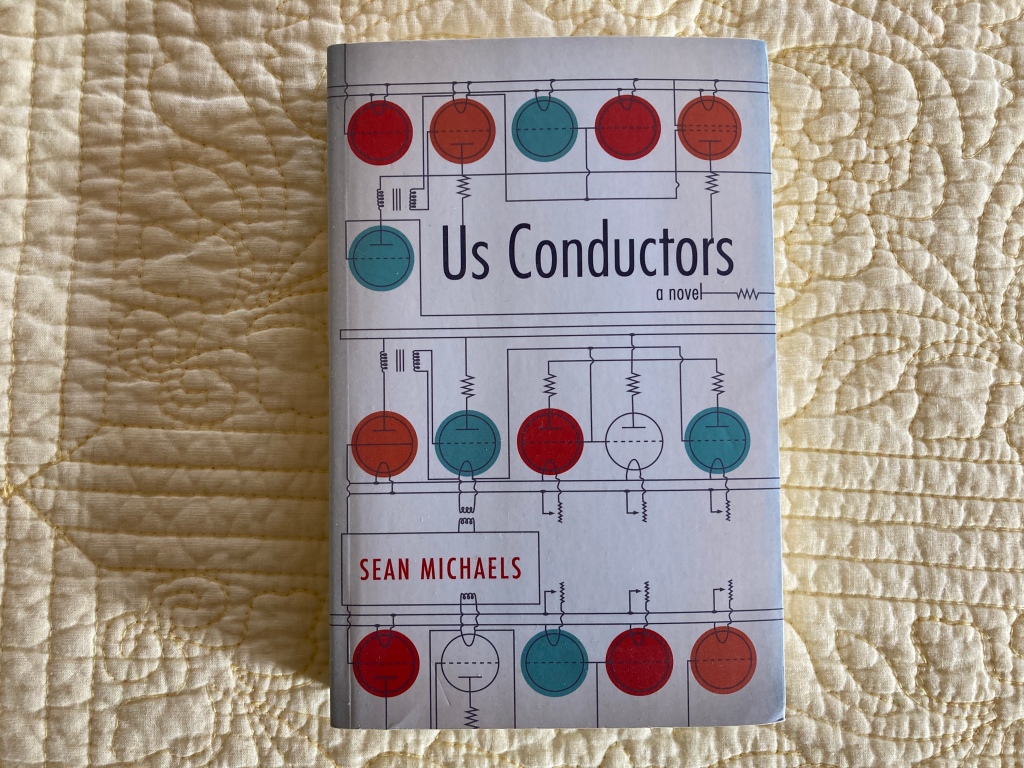
We begin with “Us Conductors,” a 2014 novel that imagines theremin inventor Lev Termen as a reluctant spy for the Soviet Union and practitioner of kung fu. Its subtitle: “In which I seek the heart of Clara Rockmore, my one true love, finest theremin player the world will ever know.”
Given the diagram on the cover, I take the title to be a reference to conductors of electricity — not only the components within the theremin but also the performer’s body, which interacts with the instrument’s electrical field. This performer gestures with both arms to create sounds, a bit like the conductor of an orchestra.
Author Sean Michaels has said the chapter titles in “Us Conductors” are the titles of new wave rock songs of the 1980s — “Music that’s really beautiful and noisy — that was the kind of feeling I was trying to carry through.” With minimal detective work I matched every title to an artist and assembled the following playlist. The only mystery is Part I, Chapter 6: “Closer.” That’s the title of a Joy Division album, but not a song from that band or era or genre, as far as I can tell.
These songs are anachronisms for a book set in the early 20th century. But throughout the narrative are references to several era-appropriate pieces of music — mostly short classical works, a lot of them performed on theremin by either Lev or Clara. Here’s another playlist.
The final composition mentioned in the book is “Bolero” (1928) by Maurice Ravel. My favorite version of this particular piece is done on the Moog synthesizer, a nephew of the theremin.
Joachim Raff’s Sinfonietta ends on a big ol’ F chord, but to me it’s not so fine and dandy.
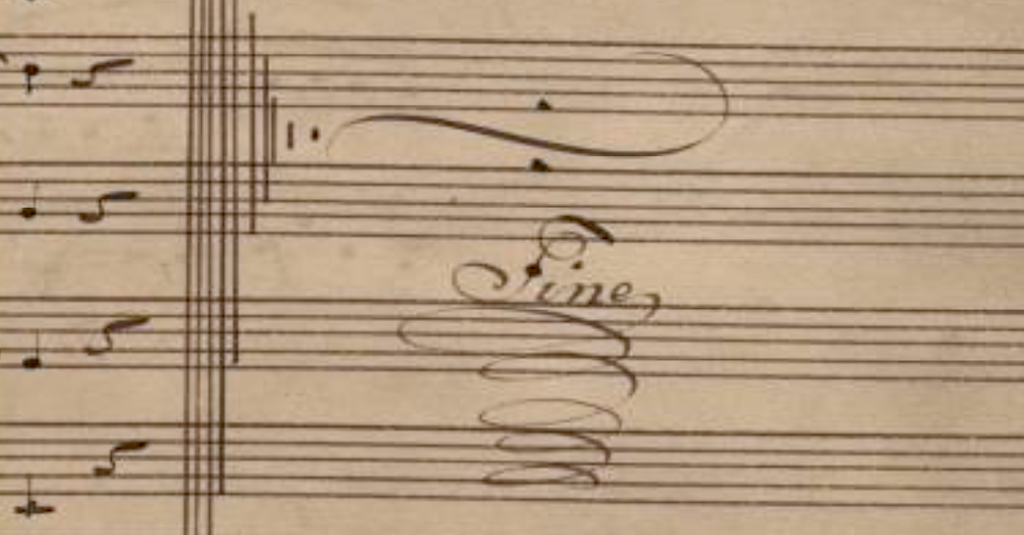
The uniformity of endings in classical music has been bothering me. Every piece seems to conclude with multiple soundings of the tonic chord. Composers will sometimes dress up these bits of aural clipart with rhythmic flair, but in most cases they stick to the dogma.
For an example, I’ll pick on “Sinfonietta” (1873) by German-Swiss composer Joachim Raff — mostly because I’ve been listening to it a lot since hearing the Holyoke Civic Symphony perform it last fall. The diminutive title is appropriate both for the length of the piece (about 25 minutes) and the stripped-down orchestra of woodwinds and French horns.
Each of the four movements is interesting, but they all conclude in the most predictable way. The first and fourth movements, in the home key of F Major, end with F chords struck multiple times. The third movement, in the dominant key of C Major, puts a C chord through descending inversions before hammering it home. By comparison, the second movement’s ending is adventurous: The tonic chord, F minor, is placed on either side of an outside-the-key C Major chord. Each time I listen, I think, Couldn’t Raff come up with anything better?
I often think back on Arthur Rubinstein’s recording of the scherzo from Frédéric Chopin’s “Funeral March” sonata. The pianist plays the movement’s final two notes in a way that I can only describe as offhand. Is he as bored with endings as I am?
Lactoria cornuta’s horns could be an offensive weapon. Or they may simply make it unpleasant for predators to swallow him. Image via Wikimedia Commons.
The jam band Phish isn’t all jamming. A handful of their songs are rigorously composed from beginning to end, some following theme-and-variations frameworks worthy of any classical composer.
No member of this subset of Phish songs is more beautifully constructed or poignant than “Horn,” which the band has been playing live since 1990 and which appears on their 1993 studio album “Rift.”
It starts like a regular rock song, with a sturdy riff. Enigmatic backing vocals enter: “Rhine wine, car horn.” Then begins a verse about a toxic relationship:
Now that you’ve deceived me and played my around and hung those nasty flyers on all the buildings in town, dribbled my possessions in a ring around the earth, and bought and sold my self-control for less than it was worth
The narrator seems to be working up to an assertive statement along the lines of, “It’s over.” But he doesn’t quite make it there. After more of the riff, he continues resignedly:
Now I know the reason that I’m feeling so forlorn. I’ll pick you up at 8 as usual. Listen for my horn.
The horn is his car horn, confirmed by the backing vocals and imitated by the beep-beep double strum that ends each repeat of the riff. As an astute forum commenter points out, it’s probably also the horn of a cuckold. Could it be the vessel holding the Rhine wine, too?
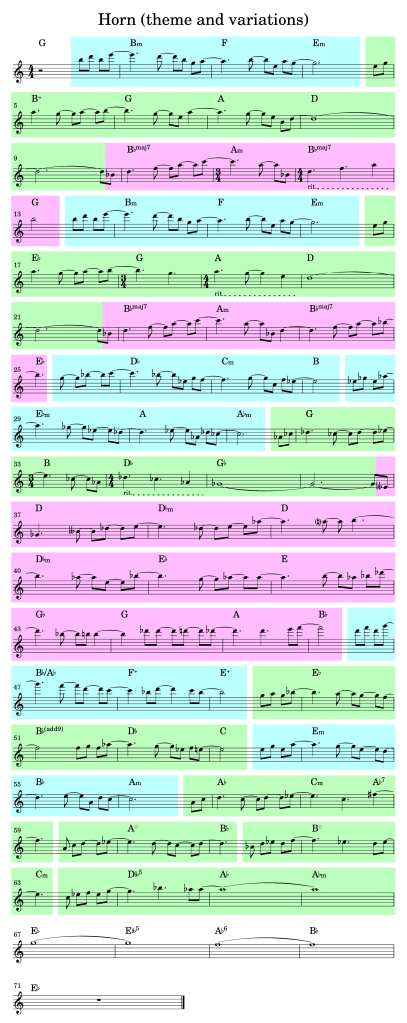
If the lyrics are the narrator apostrophizing his perfidious lover, then the long instrumental passage that follows is his tortured inner monolog, where he cycles through several conflicting emotions on his way to pick her up.
The passage is built on two contrasting themes: We could label one the voice of sentimentality and the other the voice of skepticism. Both themes go through variations as the two voices within the protagonist challenge one another.
The first theme is itself made up of two shorter phrases, each conforming to the minor pentatonic scale. The first, sad and subdued, is an acknowledgement by our hero that he has been wronged.
Theme 1, Phrase 1.
The second phrase is brighter, revealing that the protagonist still holds out hope for the relationship.
Theme 1, Phrase 2.
The two melodic phrases combine into a theme that seems to say, “She done me wrong, but remember how good it used to be?”
What follows in Theme 2 is a word from the narrator’s own better judgment. This statement is blunt. While Theme 1 takes up more than eight measures, Theme 2 gets its point across in fewer than four. It seems to say, “Dude, time to move on.”
Theme 2.
The two themes go back and forth for 71 measures — or about two minutes, more than half the song’s total running time. In that space they are restated, expanded, modulated, reoriented. Most of all they gain in vehemence. Nearing the end, one gets the impression that the protagonist has screwed up his courage. But the long, sustained notes that conclude the instrumental seem to ask a simple, melancholic question: “why?”
Finally the riff and backing vocals return as an outro. What will our hero do when his lover gets in the car?
A note on the score: I’m indebted to Chris Emmerson, whose excellent guitar transcription made this project so much easier. I was on my own figuring out the piano chords, although MrSteevt provided clues. The accompaniment is built around a chromatic line that rises and falls (mostly falls) much like the protagonist’s spirits.
Continuing a Zögernd tradition, here I encapsulate the top bodies of musical work to debut in my ears during our latest revolution around the sun.
Johannes Brahms – Ein deutsches Requiem, nach Worten der heiligen Schrift (1868)
Full of frisson-inducing placid beauty but also some absolute bangers. Notice how so many of the notes last longer than you’d expect them to. I wrote a little more about the piece here.
Sam Cooke – Night Beat (1963)
The guitar leads are kind of terrible. But if this album were too perfect we’d probably die hearing it.
The Cramps – Psychedelic Jungle (1981)
Campy vocal delivery, primitive riffs, facemelting snare delay — just the things to get you through the pandemic malaise.
Deerhoof – Milk Man (2004)
Mathy and weird but also fun and accessible. Just go with it.
Antonín Dvořák – Symphony No. 9 (“From the New World”) (1893)
Exciting, memorable melodies from wall to wall. Real meat-and-potatoes stuff. A wrote a little more about it here.
Landowner – Impressive Almanac (2017)
A proof of concept for the live band that followed, but I like the lo-fi/drum machine aesthetic best.
Norma Tanega, “Walkin’ My Cat Named Dog” (1966)
Perfectly imperfect performances of inventive, heartfelt songs from folk ballads to gospel stomps and even a march.
Gabriela Lena Frank (1972- ) writes that her string quartet “Leyendas: An Andean Walkabout” (2001) is a mixture of “western classical and Andean folk music traditions.” Yet certain parts of it take me to a different part of the world altogether.
Movements I and III, she writes, are inspired by Andean panpipes — instruments traditionally tuned to pentatonic scales. Yet the pentatonic scales used here sound, to me, stereotypically Asian. Indeed III is based on a scale that matches the yo scale typical of Japanese folk music (in this case, C#, D#, F#, G#, A# — all the black keys).
Cursory research brought me to a video of some Andean panpipes tuned to a different flavor of pentatonic scale (G#, B, C#, D#, F#), which to me sounded more stereotypically South American. They have different starting points, but in terms of intervals the scales are identical except for one note.
Safe to assume that Frank knows more about Andean music than me. I wonder when and how my brain came to identify one pentatonic scale with Asia and another with South America. Can I ever unlearn this auditory bias?
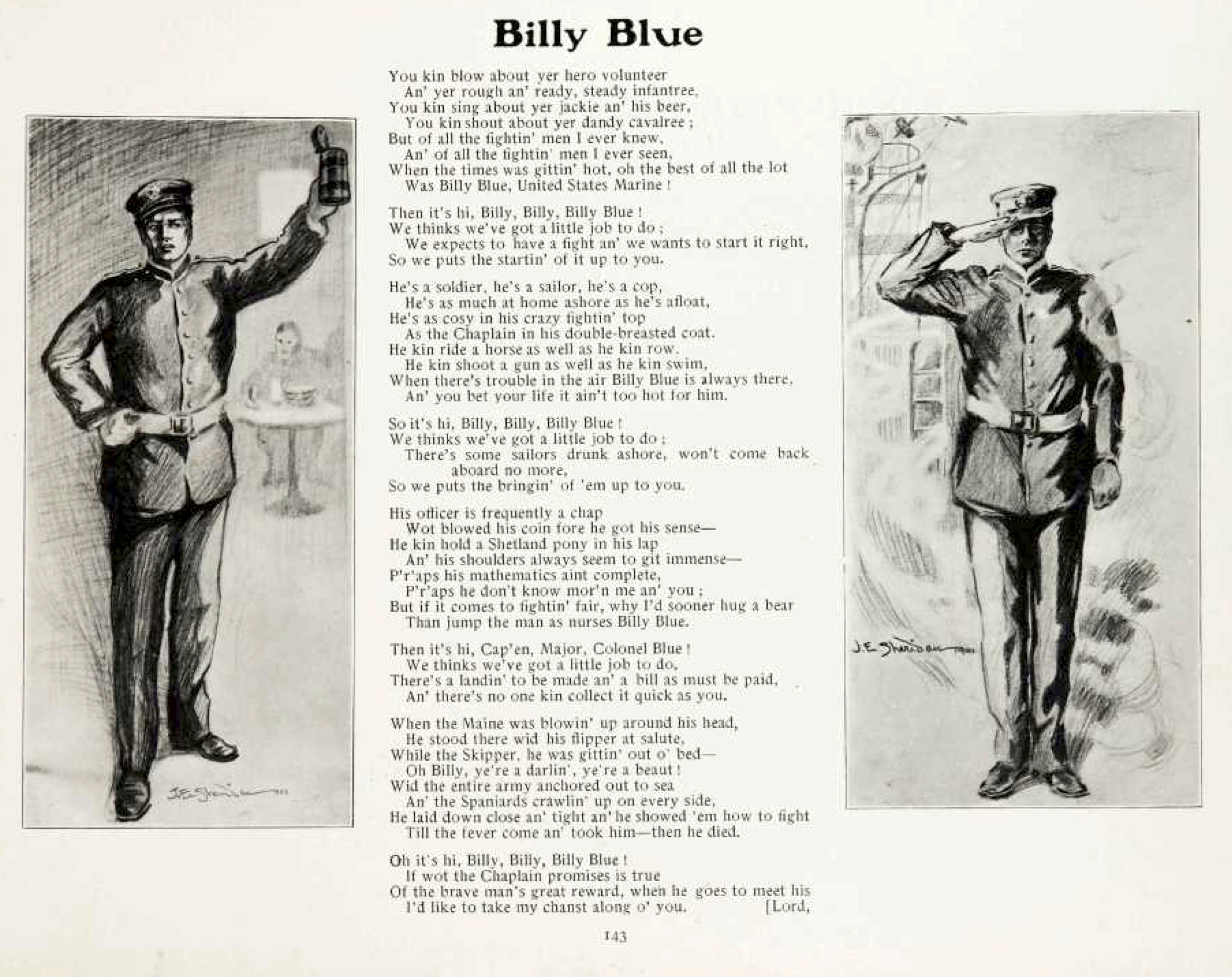
William Wallace Dew is about to join the Marine Corps and become a Billy Blue. Illustration by Ray I. Hoppman, 1917.
This is a story about what happens when a listener, even with easy access to Spotify and YouTube, can’t instantly summon a song.
Imagine the frustration — in this day and age! — of knowing a song exists and not being able to hear it. That’s what befell me while preparing my treatise on fussing and fighting.
My research led to another alliterative pairing, Billy Blue, used in early twentieth-century “songs” about the U.S. Marine Corps. Supposedly they were songs. Multiple periodicals from the time identified them as such, but provided only lyrics, no staff notation or indication from where a tune could be borrowed. There’s no trace of any recording.
The research led to more songs about historical figures and made-up characters with the same nickname, some with neither words nor music readily available. Google could take me no further, but by that point I was determined to dox Billy Blue.
Note: Discussion of each song below includes a link to its full lyrics, with my annotations, at Genius.com.
1. Let ’em bark, for we can bite
Vice Admiral William Cornwallis was shaving, so they say, when informed about an approaching enemy fleet. Illustration from “The Navy and Army Illustrated,” 1901. Artist unknown.
A century before he was a leatherneck, Billy Blue was in the British navy. Admiral William Cornwallis earned the nickname “from hoisting a ‘blue peter’ (signal for sailing) the moment after he cast anchor in any port.”1
His first appearance in song is in a historical novel, published in 1887, set just after the turn of the 19th century as England feared a French invasion and Cornwallis, as commander of the Channel Fleet, worked to prevent it. A character in the book says the song is “well known to every man here, I’ll be bound.” But it’s unclear whether the lyrics are authentic to Cornwallis’ time. Probably they were invented by the novelist, R.D. Blackmore, three-quarters of a century later.
They are mustering on yon Gallic coasts, You can see them from this high land, The biggest of all the outlandish hosts That ever devoured an island. There are steeds that have scoured the Continent, Ere ever one might say, ‘Whoa, there!’ And ships that would fill the Thames and Trent, If we could let them go there.
But England is the Ocean-Queen, and it shall be hard to do; Not a Frenchman shall skulk in between herself and her Billy Blue.2
The book provides no musical clues beyond fife and drum accompaniment on the choruses.
Two decades later, Edward Fraser retold in ballad form a 1795 naval battle known as Cornwallis’ Retreat.3 Then a vice admiral commanding a squadron of seven ships, Cornwallis defended against and ultimately evaded a French fleet three times larger. As part of the ballad details, our hero was undaunted by the odds:
He was shavin’, so they say, When he heard the news that day, And his skipper came his wishes for to larn; But he only said, ‘All right, Let ’em bark, for we can bite, For all they’re like to try on us, I don’t care a darn! Billy Blue— Here’s to you, Bill Blue, here’s to you!
2. Finger on the trigger
Billy the American marine emerged in 1900. Here he is blue because of the color of his uniform but also because he is loyal and dependable — true blue. The name Billy does not appear to refer to anyone in particular.
His first appearance is in the student newspaper of Washington’s Georgetown College, in a poem attributed to G.C. Reid of the class of ’02.4 The verses make reference to battles around the world involving the U.S. Marine Corps. Its first refrain ends in an unfortunate rhyme scheme:
Then it’s: Hi! get your gun, Billy Blue, There’s going to be some fun, Billy Blue! And it doesn’t cut a figger If it’s “Chinee,” “Don,” or “Nigger,” When your finger’s on the trigger, Billy Blue!5
The next year the college yearbook printed, without attribution, a remarkably similar poem, rendered in low-class dialect but scrubbed of overt racial slurs. Its first refrain looks familiar:
An’ it’s hi Billy, Billy, Billy Blue! We think we’ve got a little job to do: We expect to have a fight an’ we want it started right, So we puts the startin’ of it up to you.6
This version was published again, with minor revisions and under the title “The United States Marine,” in a New York magazine in 1901.7 This time it bore the name of Maurice Brown Kirby, a 1898 Georgetown graduate.
Conrad Reid argued the negative position on the Georgetown debate team, winning the prestigious Merrick medal. Photo from the Georgetown Hodge Podge.
Kirby and Reid’s compositions both have refrains with AABBA rhyme schemes where the A lines are longer than the B lines. Additionally, both songs reference the explosion aboard the USS Maine in Havana Harbor in 1898, one of the inciting incidents of the Spanish-American War.8
Who can say, at this late date, whether Kirby ripped off Reid or vice versa? Perhaps Billy Blue was created collectively in the halls of Georgetown.
Both Reid and Kirby were native Washingtonians. Both published other poems in the college newspaper before and elsewhere after graduating. Neither appears to have served in the military, though one did have a marine pedigree.
George Conrad Reid, who went by his middle name, was born in 1881. He was a Georgetown man throughout his life. As an undergraduate he won the distinguished Merrick Debate Medal, arguing against the proposition that “dependent colonies would be a benefit to the United States.” He went on to earn a Georgetown law degree in 1905 and then joined the faculty as an “instructor in the law of personal property, real property and torts.” His last appearance in the yearbook is 1919.
George Croghan Reid the elder circa 1905, via the Internet Archive.
A law school publication in 1936 said he had a “responsible position in the government service.” He remained active in alumni affairs, sometimes writing poems and songs about his alma mater, nearly until his death in 1966.
Conrad Reid was the only child of George Croghan Reid, who retired from the Marine Corps as a brigadier general. The elder Reid was also an “able lawyer,” according to his obituary. He died of a stroke in 1914. In his will he left his son a gold watch, and a grandson who bore his name received his “sword, uniforms, and commissions.”
A cousin of Conrad Reid, also named George Croghan Reid, also retired from the corps as a brigadier general. He received the Medal of Honor in recognition of the “small percentage of the losses of marines under his command” in the Battle of Veracruz during the Mexican-American War in 1914. Earlier in his career he was involved in two engagements mentioned in his cousin’s poem — the Spanish-American War and the Boxer Rebellion.
Obituaries indicate Conrad Reid had a son and a grandson who were also marines.
George Croghan Reid the younger circa 1925, via USMC Archives.
Maurice Brown Kirby was born in 1875. He played football for Georgetown in the days before helmets and pads, and was badly injured in a game that also saw one of his teammates killed, which may explain why he didn’t graduate until he was 23. He was also in the glee club.
In 1901 the Washington Post published another of his poems, “Skipper Schley,”9 about a Navy admiral during the Spanish-American War. In form and style it is virtually identical to his version of Billy Blue.10 A later article in the Post details how Kirby came to write it:
“Skipper Schley” is in reality the versification of a chat which Mr. Kirby had in person with one of the crew of the Brooklyn, Admiral Schley’s flagship, shortly after the battle of Santiago [off the coast of Cuba]. With the majority of his countrymen, this sailor repudiates all insinuations against his famous commander and eulogizes him in the picturesque language of the jack-tar. As Mr. Kirby has spent many years in a careful study of the United States enlisted man, his verse is not only a tribute to Admiral Schley, but an excellent portrayal of the man behind the gun.11
This article indicates Kirby set the poem to music, creating a ballad with a “martial air.” Around the same time the Washington Times gushed that the song had an “infectious swing that should place the composition among the popular hits of the day.” Here was my most tantalizing clue. Once again I could turn up no record of the actual tune.
Maurice Brown Kirby, pictured in 1911 or earlier, was a newspaperman, press agent, and playwright before his untimely death. Photo via the Library of Congress.
After abandoning law school Kirby moved to New York City, writing for newspapers and magazines as well as working on Broadway. He was involved in a production of the “The Gay Hussars,” described as a “military operetta” originating in Hungary. The program cover says the work was “adapted for the American stage” by Kirby, and the lyrics to its showstopper, “Oh! You Bold, Bad Men,” are attributed to him. This song, at least, is wellpreserved.
The show was rushed to the stage in July 1909 in Atlantic City after rival producers threatened to put on their own version. When “The Gay Hussars” arrived on Broadway proper later that month, a New York Times critic panned it. It survived at the Knickerbocker Theater a little over a month. The show got a kinder review in Kirby’s hometown, where it played at the National Theater for a week in October.
Kirby suffered a severe head injury late one night in 1911 in New York. The Washington Post reported he was “found unconscious at the foot of a subway entrance Friday, having slipped and fallen there, the police believe.”12 Other Washington papers asserted he had been brutally mugged. In any case, he died four days later, leaving a wife and 3-year-old daughter. He was 35.
3. Go and get ’em demon
Whoever originated Billy Blue, it was Kirby’s version that endured, at least for a time. It was resurrected in 1917 when multiple newspapers, hungry for patriotic content as the United States entered World War I, reprinted it.
One paper called it the Marine Corps’ “favorite song,”13 while another asserted it “has been adopted as the song of the Corps by the Marines.”14 Individual marines or their units may indeed have sung it, but this apparently was not an official adoption. When I called the National Museum of the Marine Corps and the United States Marine Band library, neither had any record of its existence.15
Also in 1917, newspaper cartoonist Ray I. Hoppman picked up and ran with the Billy Blue concept, publishing verses following an AABBA structure virtually identical to Reid and Kirby’s, as well as recycling some of their ideas. The first stanza:
He’s a soldier and a sailor, every inch; He’s a fighter for his country in a pinch; And the foemen do not figure When his finger’s on the trigger— He’s a “go and get ’em demon,” that’s a cinch.16
The Recruiter’s Bulletin described Hoppman’s as “one of the most popular” songs about the corps, saying it “has been sung to adaptations of various popular songs.” The Bulletin that summer ran three other Hoppman poems that incorporated the nickname Billy Blue, including one more with an AABBA structure. All of them incorporated the nickname Billy Blue.
But for all Hoppman’s enthusiasm, Billy Blue evidently was never a commonly used nickname for marines. That could be because marines already had a longstanding nickname: leatherneck.
Indeed, an entry years later in a Marine Corps magazine called “Leatherneck” denigrates the Billy Blue nickname. In a passage styled after a telegram, a fictional correspondent covering a Marines vs. Army football game tells his editor:
ONE OF THE CHIEF DRUM-BEATERS FOR THE TEAM, JACK JAMES OF THE EXAMINER HERE INSISTS ON CALLING THE TEAM, “THE BILLY BLUES” OR “THE BILLY BLUE TEAM.” CONTACT POLICY AT HEADQUARTERS TO SEE IF THEY CAN’T GET HIM TO KNOCK IT OFF. THAT’S NO NAME FOR MARINE OUTFIT.17
Blue already had other, stronger associations — including with different uniformed services. Today we refer to dark blue clothes as “navy blue,” a holdover from the Royal Navy of the mid-1700s. For decades after the American Civil War, the term “boys in blue” was associated with Union Army soldiers. “Boys in blue” (or the updated “women and men in blue”) is sometimes applied to the police, a usage that goes back at least as far as 1890s England.
All of this could help explain why the Billy Blue songs never caught on, and why their melodies are likely lost to history. But their structural similarity to some other martial songs gives some clues about how they might have sounded.
One possible template or cousin is “The Monkeys Have No Tails in Zamboanga.” The lyrics follow the AABBA format and the tune, identified by one source as a “parody on an old Spanish song,” was picked up by American soldiers stationed in the Philippines during the Spanish-American War in 1899, just before the appearance of Reid’s lyrics.18 “Hinky Dinky, Parley-Voo?” aka “Mademoiselle from Armentières” also bears a resemblance and may have similar Filipino origins by way of the British Army.19
But the closest match is “Sergeant Flynn,” about the 1876 battle between the Army’s 7th Cavalry Regiment and three allied Native American tribes, popularly known as the Battle of Little Bighorn or Custer’s Last Stand.
Garryowen, Garryowen, Garryowen In the valley of Montana all alone There are better days to be In the 7th Cavalry When we charge again for dear old Garryowen.
As a nickname for the regiment, Garryowen is taken from yet another piece of music, an Irish drinking song of the 18th century that became the 7th’s official air during Custer’s time.
I learned “Sergeant Flynn” circa 1997, shouting along with other Boy Scouts at Camp Wanocksett in Jaffrey, New Hampshire. The tune employed there was recognizable to anyone who’d ever been to kindergarten: “If You’re Happy and You Know It Clap Your Hands.”20
An archival recording on the University of New Mexico Libraries website demonstrates it was sung the same way almost 50 years earlier. The performer doesn’t have the chords quite right but you get the idea.
Without specifying the melody, a retired lieutenant general attested to “Sergeant Flynn” being “particularly popular among cavalrymen in 1935 ‘when we as young lieutenants sang it at the drop of a hat with a drop of bourbon at Fort Riley.'”21 But I have been unable to determine whether “Sergeant Flynn” originated around the time of Custer’s defeat or whether it’s a more recent invention.
4. Lover, not a fighter
By the time Billy turned back up in the 1960s, he had left the military behind, trading the literal blue of his uniform for the metaphorical blue of sadness. He also became easier to hear, having been preserved on 45-rpm singles and even YouTube.
In a town the size of my hometown News good or bad soon gets around So I guess they found out we are through That’s why they call me Billy Blue.
The song was penned by prolific Nashville songwriter John D. Loudermilk, who had a No. 1 hit when Paul Revere and the Raiders recorded “Indian Reservation” in 1971.
If there’s any link here to the Billy Blues of old, it’s fear of French conquest. On the B-side, written by Felice and Boudleaux Bryant, Salvo sings about how he regrets giving his girlfriend a French poodle, because “she loves him better than she loves me.” The song concludes: “Don’t ever trust a Frenchman with a woman you love.”
Around the same time, Billy featured on a 45 from the obscure Ron-Cris label of Connecticut. Sonically, Sherry Connors’ “Billy Blue” is a slightly more dignified version of the Royal Teens’ “Short Shorts.” This time, Billy is the heartbreaker.
Billy, Billy, Billy Blue I don’t know what I’m gonna do-oo-oo You ran away with someone new-ew-ew And now I’m left with just the blue-ue-ues Oh Billy Blue, Billy Blue, come back I need you so Oh Billy Blue, Billy Blue, Billy Blue
In 1970 Billy crossed back over the ocean, turning up as a Decca B side by the Dutch band Popcorn, fronted by Roek Williams. I’ve been unable to obtain a copy.
Another Dutch artist, Bruce Low, cut a “Billy Blue” single in 1979. The German lyrics (as translated by Google) tell the story of an alcoholic who gets sober after a visit from God. This recording is easy to find online; there’s even a curiously out-of-sync video of Low lip-syncing it on TV.
But why should a song sung in German feature a character with an English name? Because English is the song’s mother tongue, as penned by two more Nashville journeymen, Kermit Goell and Billy Sherrill. (Perhaps the lyrics were autobiographical for one of the writers?) Evidently the song was never recorded in English, though. The translator was Low, who was famous for teutophone adaptations of country-western songs, in particular “There’s a Bridle Hangin’ on the Wall.”
Sherrill and Goell’s only other shared writing credit is on Charlie “Silver Fox” Rich’s recording of “America the Beautiful.” The only substantial difference from the traditional patriotic anthem is a spoken intro that has the country’s major immigrant groups render the song title in their native tongues. Here is another German connection: “And in the beer halls of Milwaukee it’s ‘Vie schoen das Land.'”
Billy then kept a low profile until 1990, when he turned up as the title track on an EP by British shoegazers Faith Over Reason, an early project for singer-songwriter Moira Lambert. The lyrics seem to be describing a midnight walk with a lover.
Running in the rain but my eyes are dry Warm in your smile, there’s no need to ask why Your tongue on your teeth, your hand’s in my hand Billy Blue and I are almost there, almost there
Just last year, Italian rapper Marco Sentieri released a song about bullying, written by Giampiero Artegiani, called “Billy Blu.” “[T]he song emphasizes that the phenomenon of bullying is the mirror of an increasingly life frantic, which diverts the attention of parents away from their children,” states an online article about the track.22 It says Sentieri planned an anti-bullying tour of schools that was canceled because of the coronavirus pandemic.
5. The spectrum broadens
A number of 20th- and 21st-century performers have used the name Billy Blue.
The only one active today is a Miami rapper. According to a press release announcing his 2012 mixtape, “His experiences are what gave him his nickname: ‘Billy’ taken from ‘Billy the Kid’ and ‘Blue’ because after his mom died he was always sad.” One of his most recent music videos, for “Hell Below,” is dedicated “in loving memory of unarmed victims of police shootings.”
Another Florida entertainer told a newspaper reporter in 1990 that his colorful stage name was literal.
Blue said he chose his stage name, Billy Blue, after performing for a time as Billy White in the White Elephant Restaurant, wearing a white tuxedo, white gloves and shoes and playing a white baby grand piano on a white fur rug. Later, he began playing a piano painted iridescent blue in a North Carolina restaurant decorated with blue [tablecloths], carpet and waitress uniforms. He decided to dress in blue and call himself Billy Blue. The name stuck.23
Playing clubs in Buffalo and Boston in the 1990s was a group called Billy Blue and the Blazers. In 2006 the frontman recorded an album called “Blues in My Room.” (“Billy blue blazes” is a phrase used to describe hellish heat, personified at DePaul University, a Catholic school in Chicago, in athletics mascot Billy Blue Demon.)
Scattered across newspaper databases are references to guitarists “Billy Blue” Graham and “Billy Blue” Mitchell, as well as to Billy Blue and Karaoke Two.
In Northern Ireland, time unknown, a Protestant singer and accordionist recorded songs like “I Am a Loyal Orangeman” and went all the way to the other side of the color wheel in choosing the moniker Billy Blue. Both colors are associated with the Orange Order (although the blue in their sashes looks purple to me). The name Billy could be a reference to King William III, remembered as a champion of the faith.
There’s even a link between Billy Blue and Johnny Cash. An act called Billy Blue cut two 45s for the Vanco label of Vancouver, Washington, probably in the early 1970s, and one side was a cover of “Folsom Prison Blues.” In the present day, a Swiss outfit called Billy Blue and the Bandits does “Folsom Prison” in its live set.
As much as I’ve learned about Billy, he’s still a mystery to me. If you know of any more songs he’s in, or have a 120-year-old music score in your attic, get in touch at zogernd [at] gmail [dot] com.
Related
Billys Blue with little or nothing to do with music
I came across a lot of irrelevant, but still kinda interesting, information through my research on songs about characters called Billy Blue.
4. Appearing the same year was a poem by Minna Irving in which Billy Blue is a “U.S. regular soldier,” i.e., a member of the Army. Hartford Courant, 13 July 1900, p. 15.
5. Reid, G.C. “‘Billy Blue,’ U.S. Marine.” Georgetown College Journal. Washington, December 1900, p. 114. Online: https://repository.library.georgetown.edu/handle/10822/1049758. Accessed 2 June 2021. The poem also appeared under Reid’s name in the Washington Post of 13 Jan. 1901, and in Joseph Leroy Harrison, ed., “In College Days: Recent Varsity Verse,” Boston: Knight & Millet, 1901, p. 25.
9. Kirby, Maurice B. “Skipper Schley.” Washington Post, 4 Aug. 1901, p. 20.
10. There are further similarities. One line, describing the humble origins of either the sailor or the marine, is substantially the same in both poems: “P’r’aps his mathermatics aint complete” vs. “We’re sure our mathematics ain’t complete.” Both songs also have fuss/fight lines: “When there’s fun or fuss or fight, / The boy to keep in sight / Is Billy Blue, United States Marine” vs. “He is better in a fight than in a fuss.” Lastly, Schley is described by his men as “truest blue.”
11. “‘Skipper Schley’ Set to Music.” Washington Post, 4 Oct. 1901, p. 2.
12. “KIRBY KILLED BY FALL: Writer Succumbs to Injuries in New York. GRADUATE OF GEORGETOWN Washingtonian Found Fatally Hurt at Foot of Subway Entrance in Metropolis. Was Author of Plays and Poems. Mother at His Side When End Comes. Wife a New York Girl.” Washington Post, 28 March 1911, p. 3.
15. Since 1929 the official song of the corps has been “The Marines’ Hymn” (“From the Halls of Montezuma, / To the shores of Tripoli, / We fight our country’s battles / On the land and on the sea.”). It’s based on music by French composer Jacques Offenbach dating to 1867, with anonymous lyrics added later.
20. A commenter on mudcat.org recalls singing “Sgt. Flynn” the same way as a Boy Scout in the 1960s.
21. Campbell, Maj. Verne D. “Armor and Cavalry Music: A Survey of Songs and Marches—and the units that rode to their strains.” Armor. Washington, March-April 1971, p. 33. Online: https://www.google.com/books/edition/Armor/yi25U18BQhcC. Accessed 3 June 2021.
What’s this all about? I came across a lot of irrelevant, but still kinda interesting, information through my research on songs about characters called Billy Blue. Here’s a sampling of other Billys Blue with little or nothing to do with music.
Portrait of William “Billy” Blue by J. B. East (1834). State Library of New South Wales via Wikimedia Commons.
an early inhabitant of Sydney, Australia, about whom much has been written and for whom a ton of stuff is named
on “Mighty Morphin’ Power Rangers” (1993-1996), the Blue Ranger’s name was Billy
the phrase “Billy blue blazes” refers to hellish heat
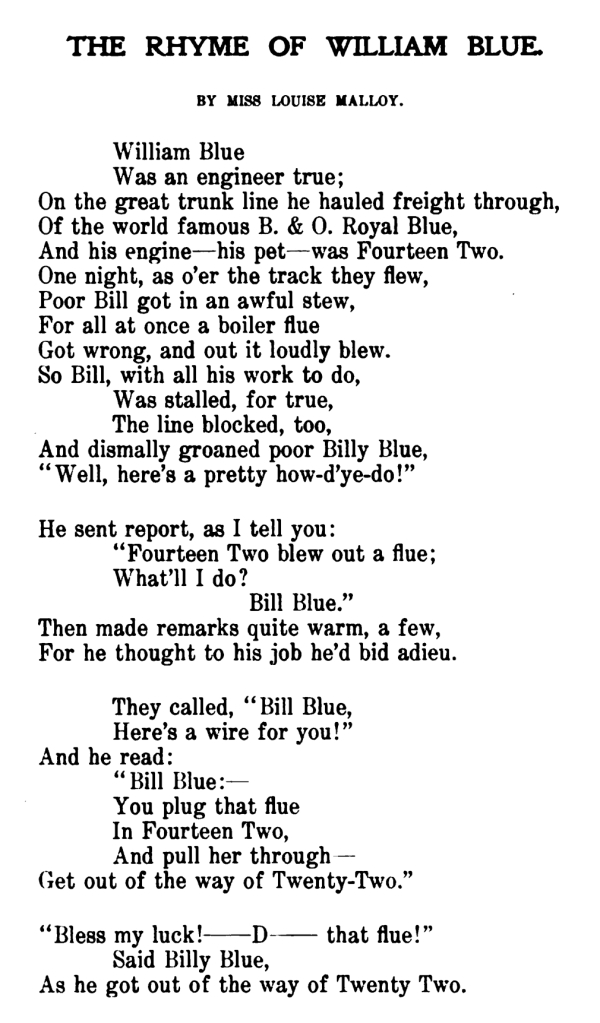
an engineer on the Baltimore & Ohio Railroad’s flagship, “Royal Blue,” as described in a poem in a trade magazine from 1899
Malloy, Louise. “The Rhyme of William Blue.” In “The Book of the Royal Blue,” published monthly by the passenger department of the Baltimore & Ohio Railroad, Baltimore, June 1899, p. 22.
Related
Soldier, sailor, av’rage guy
Imagine the frustration — in this day and age! — of knowing a song exists and not being able to hear it.
It’s the 30th anniversary of “The Unforgiven,” the second single of Metallica’s black album. To celebrate, I made a dub reggae remix.
Thanks to the folks who uploaded all the original audio stems onto YouTube. Drums by cmdr_chill via WikiLoops. Other added instruments by me. Thanks also to Justin for technical assistance.
Musicians of the Springfield Symphony Orchestra perform Oct. 15, 2021. Get a load of that badass black cello. Still taken from Focus Springfield’s livestream.
This month, within six days and 20 miles of each other, the Pioneer Valley Symphony and the Musicians of the Springfield Symphony Orchestra both gave incomplete performances of Antonín Dvořák’s “From the New World” (Symphony No. 9, 1893).
The abridgment, at least in one case, was born of necessity. MOSSO had just one afternoon to rehearse with its conductor, and wanted to play portions of several other pieces. It played only the outermost movements of the Dvořák, skipping the second and third.
PVS centered its program on the symphony, applying the idea of a new world to a planet upended by pandemic. Nonetheless it skipped the third movement.
Both performances were forward-looking in an optimistic way. And both were lovely renditions. One couldn’t help but notice, though, that something was missing.
And that’s as it should be. There is in fact a lot missing from this new world — foremost the 4.5 million people (that we know of) who have succumbed to the disease so far. It’s a bit hard to sustain optimism in the face of a reminder like that. But there is still music.
The Pioneer Valley Symphony in a performance broadcast Oct. 9, 2021.
I was listening to a symphony that just wasn’t doing it for me. Impatiently I looked at the iTunes progress bar to see how much was left. Not that much. OK, I thought, I can get through this.
Generally I’d rather not know exactly where a piece of music is going to end up — I’d rather be surprised. But in this situation, having the finish line in sight made an underwhelming listening experience more tolerable.
It’s a small confirmation of research from the 1980s that found “those who waited whilst watching a progress bar described an overall more positive experience.”













 Zögernd
