Arched ceiling: Ethereal melodies sung through a too-quiet PA. Book-lined walls: Languid guitar strums multiplied by long, thick delay. Concrete floor: Wheezing drums, just as slow as the Omnichord will play them. They sit crosslegged, hunched, obscured by a folding chair, building.
(Bobbie at Bookends, Florence, Mass., 7/7/24)
* Concise Historical Impression of a Recording or Performance
Decades of popular music have conditioned us to expect every song’s title to correspond to words from that song’s refrain. We can see the lyrics confer authority upon the title just as the title substantiates the lyrics.
But from time to time we witness a breakdown in this reciprocity. When there isn’t an exact match between title and lyric, we may be puzzled, or amused, or confounded.
There are plenty of cases where the title bears zero resemblance to the lyrics — or even their subject matter. Classic examples are The Who’s “Teenage Wasteland,” which is actually called “Baba O’Riley,” and Bob Dylan’s “Everybody Must Get Stoned,” which is officially known as “Rainy Day Women #12 & 35.” The catalogs of the Beatles and the Monkees are shot through with songs possessing this kind of dissociative identity disorder.
Odd as they are, however, such incongruous titles don’t contradict the songs with which they’re associated. They merely stand apart. And by standing apart so conspicuously, the black sheep is bound all the more tightly to the flock.
More intriguing are songs where title and lyric are similar but not quite the same. In these instances, the definitive version does not exist. Neither title nor lyric can be deemed correct or incorrect. All we can do is sit back and and watch them bicker.
While many examples of mismatches follow below, special distinction belongs to “Na Na Hey Hey Kiss Him Goodbye” by Steam (1969). The title isolates the song’s distinctive non-lexical vocables and other keywords, respecting neither their number nor their sequence. Meanwhile, the song has followed a remarkable trajectory. While it began as the pleadings of a jealous voyeur, its chorus has become the universal chant used to belittle athletic failure. Its recognizability has long eclipsed its awkward title.
Discrepancies between title and lyric may be superficial or significant, and they may happen for practical, whimsical, or unintentional reasons.
While lyricists’ imagination and tendency to obey meter may yield extended phrases — and although these extended phrases may be very catchy or memorable — commercial interests often demand concision. In other words, a shorter title is usually more practical than a longer one.
Practicalities of intellectual property, branding, and polite society must also be observed. There may be an interest in avoiding titles that are controversial1 or duplicative of recognizable songs of the past.
Of course the decision to shorten a title may be totally impractical. People like to abbreviate and use pet names. Sometimes the informal moniker is recorded on the birth certificate.
Lastly, unintentional alterations of the title are a possibility, especially on pre-digital printed materials like record sleeves. Typographical errors and other careless mistakes are bound to happen.
There are a couple examples of mismatches being reconciled. One holiday staple started out in 1951 with a simplified title, but subsequent releases include the full phrase: “It’s Beginning to Look a Lot Like Christmas.” A 1955 Fats Domino single was initially labeled “Ain’t It a Shame,” but later became “Ain’t That a Shame,” matching what was sung.
Whatever their cause, mismatched titles generally present in seven forms. What follows is an ever-expanding list of examples. I’m greatly indebted to members of the Steve Hoffman Music Forums who identified several qualifying entries in 2009. Send additions to zogernd [at] gmail [dot] com. Bonus points if you can find an example where the title is wordier than the lyric.
1. Loss of specificity
By Fire — Hiatus Kaiyote (2015)
Lyric: Direct to the old Navajo by the fire Discussion: The title calls to mind a metaphorical trial by fire. But in the song it’s a literal campfire.
The Same Does Not Apply — Rustic Overtones (2009)
Lyric: The same does not always apply
Another Day In Paradise — Phil Collins (1989)
Lyric: ’Cause it’s another day for you and me in paradise
Living for the City — Stevie Wonder (1972)
Lyric: Living just enough, just enough for the city
Won’t Get Fooled Again — The Who (1971)
Lyric: Then I’ll get on my knees and pray / We don’t get fooled again Discussion: There’s a world of difference between praying not to get fooled and being foolproof.
What Is Life — George Harrison (1970)
Lyric: Tell me, what is my life without your love?
She’s a Rainbow — The Rolling Stones (1967)
Lyric: She’s like a rainbow Discussion: The title is a metaphor. The lyric is a simile. Maddening.
Don’t Talk to Strangers — The Beau Brummels (1965)
Lyric: Don’t you go talking to strangers Also: Don’t you dare go unto strangers And: Don’t you go runnin’ to strangers
I’ll Feel a Whole Lot Better — The Byrds (1965)
Lyric: And I’ll probably feel a whole lot better when you’re gone Discussion: The title declares, but the lyric equivocates.
(You’re My) Soul and Inspiration — The Righteous Brothers (1966)
Lyric: You’re my soul and my heart’s inspiration
2. Omission of intensifiers
We Are Never Ever Getting Back Together — Taylor Swift (2012)
Lyric: We are never ever ever [ever] getting back together Discussion: Both Taylor and Bryan Adams (see below) employ repetition in their lyrics to eliminate ambiguity. Their titles delete the duplicate words, but still end up being fairly long.
Have You Ever Really Loved A Woman — Bryan Adams (1995)
Lyric: So tell me have you ever really, really, really ever loved a woman
They Don’t Care About Us — Michael Jackson (1995)
Lyric: All I wanna say is that they don’t really care about us
Blame It On Your Heart — Patty Loveless (1993)
Lyric: Blame it on your lyin’, cheatin’, cold, dead-beatin’, two-timin’, double-dealin’, mean, mistreatin’, lovin’ heart Discussion: This string of accusatory adjectives would’ve taken a week to scroll across your iPod screen, but the more economical title hardly captures the spirit of the song.
Boom! Shake the Room — DJ Jazzy Jeff and the Fresh Prince (1993)
Lyric: Boom! Shake, shake, shake the room
I Really Love You — The Stereos (1961)
Lyric: I really, really love you
3. Simplified pairings
Hot N Cold — Katy Perry (2008)
Lyric:Cause you’re hot and you’re cold
Love/Hate — Liz Phair (2003)
Lyric: It’s a war, all the love and hate
Alone + Easy Target — Foo Fighters (1995)
Lyric:I’m alone and I’m an easy target
Right Place Wrong Time — Dr. John (1973)
Lyric:I was in the right place, but it must’ve been the wrong time
Sunshine Superman — Donovan (1966)
Lyric: Sunshine came softly through my a-window today Also: Superman or Green Lantern ain’t got a-nothin’ on me
4. Substitution
Off He Goes — Pearl Jam (1996)
Lyric:There he goes with his perfectly unkempt clothes/hope
What’s Up — 4 Non Blondes (1992)
Lyric: And so I wake in the morning and I step outside / And I take a deep breath and I get real high / And I scream from the top of my lungs, “What’s going on?” Discussion: The possibly apocryphal story goes that the San Francisco band’s breakthrough was retitled because Marvin Gaye already had a hit in 1971 with “What’s Going On.”
Other Arms — Robert Plant (1983)
Lyric:Lay down your arms
Young Turks — Rod Stewart (1981)
Lyric: Young hearts be free tonight Discussion: The official title captures the protagonists’ rebellion but not their romance. The lyric is awfully similar to Candi Staton’s 1976 disco hit “Young Hearts Run Free.”
Open the Door, Homer — Bob Dylan & The Band (1975)
Lyric: Open the door, Richard
Gimme Little Sign — Brenton Wood (1967)
Lyric: If you do want me, gimme little sugar Also: Just gimme some kind of sign, girl
5. Contradiction
Without You — Pugwash (2017)
Lyric: What did you do all day without me?
Jesus Wants Me For A Sunbeam — The Vaselines (1992)
Lyric: Jesus don’t want me for a sunbeam Discussion: Nirvana made this song famous with their “MTV Unplugged” cover, retitling it “Jesus Doesn’t Want Me For a Sunbeam.” The Vaselines sing “Jesus don’t want me,” but their title asserts the opposite. However, in the 2009 live version above, they introduce the song using the “Doesn’t” title. The song parodies a children’s hymn called “I’ll Be a Sunbeam.”
Strawberry Letter 23 — Shuggie Otis (1971)
Lyric: A present from you, Strawberry Letter 22 Discussion: Otis has said the song describes lovers exchanging letters in strawberry-colored envelopes. As a reply to the 22nd such letter, the song is letter 23.
6. Duplication
Star Star — The Rolling Stones (1973)
Lyric: Starfucker Discussion: Funny how the sanitized title replaces the expletive not with asterisks, but with the word star.
Tighter, Tighter — Alive N Kickin’ (1970)
Lyric: Hold on just a little bit tighter now, baby
Cherry, Cherry — Neil Diamond (1966)
Lyric: Hey, she got the way to move me, Cherry / (She got the way to groove me) / Cherry, baby
7. Superficial differences
Blinding Lights — The Weeknd (2019)
Lyric: Oooh I’m blinded by the lights Discussion: The lyric evokes Bruce Springsteen’s “Blinded by the Light” (1973), better known as a 1977 hit for Manfred Mann’s Earth Band.
Blinded by the Lights — The Streets (2004)
Lyric:Lights are blinding my eyes Discussion: The title is only one letter different from Springsteen’s. Rather than avoiding similarity to another recognizable title, this one goes out of its way to create similarity.
Semi Charmed Life — Third Eye Blind (1997)
Lyric: I want something else to get me through this semi-charmed kind of life
Who’ll Be the Fool Tonight — Larsen|Feiten Band (1980)
Lyric:Who will be the fool tonight Discussion: “Maybe they ran out of room on the album spine,” speculates co-host David B. Lyons on the “Beyond Yacht Rock” podcast (“Camaro Summer,” July 8, 2016, starting at 3:44).
All My Love — Led Zeppelin (1979)
Lyric: All of my love
Bad Moon Rising — Creedence Clearwater Revival (1969)
Lyric: I see a bad moon arising Also: There’s a bad moon on the rise
Everybody’s Got Something to Hide Except Me and My Monkey — The Beatles (1968)
Lyric: Everybody’s got something to hide ’cept for me and my monkey
MacArthur Park — Richard Harris (1968)
Lyric: MacArthur’s Park is melting in the dark
Reach Out of the Darkness — Friend and Lover (1968)
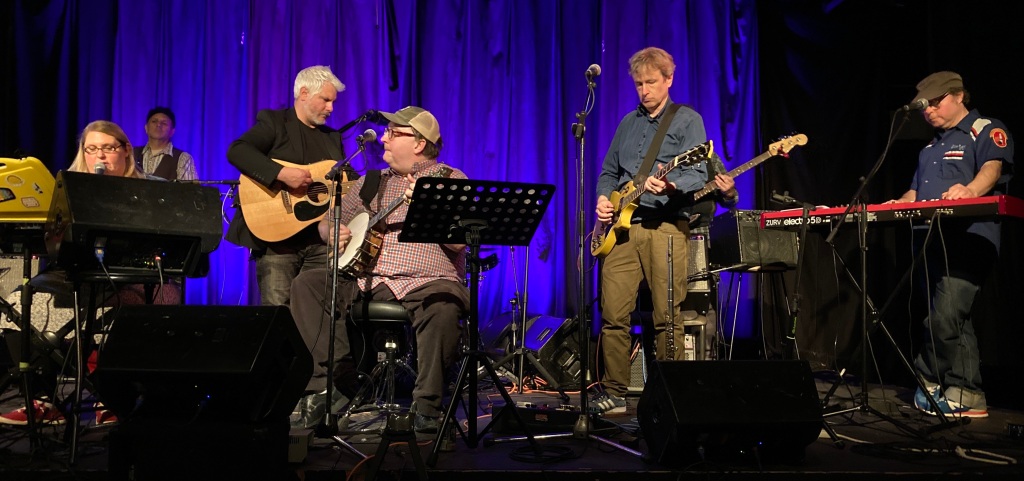
Recently shuttered venue. Nine refined musicians crammed onstage. Immaculate mix, not too loud. Mounted cameras plus roving lensman. Invitation-only audience, mostly players themselves. Silly banter to keep things loose. No taboo against restarting songs after flubs. Comfortable.
(King Radio at the Divine Theater, Holyoke, Mass., 4/3/24)
* Concise Historical Impression of a Recording or Performance
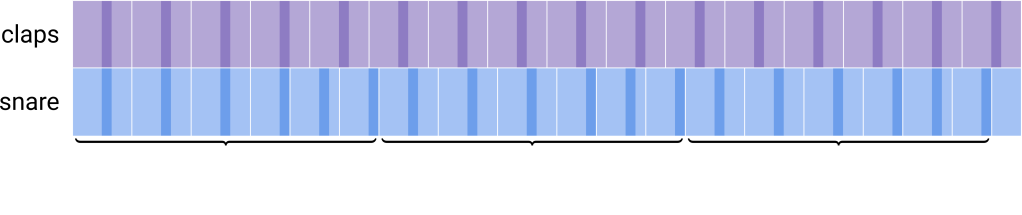
On Reddit someone’s posted an overcomplicated guide to the polyrhythmic drum intro on Phish’s “Mound” (from “Rift,” 1993). Here’s the real deal:
3 bars of 6/4 1 bar of 4/4 1 bar of 5/4 1 bar of 4/4
The form repeats three times. The snare always lands on beat 4, regardless of the time signature. The handclaps provide a frame of reference, staying in 6/4 time throughout and always falling on the 4.
Related
Assertively resigned, resignedly assertive
The Phish song “Horn” features theme and variations worthy of any classical composer.
Songs that strictly color within the lines have no appeal, but indiscriminate scribbling is hardly the answer.
Every now and then, you’ll come across a page in the coloringbook of pop music where someone has put the wrong color in just the right place. What might have been a perfectly neat but bland time-killer is instead worthy of framing.
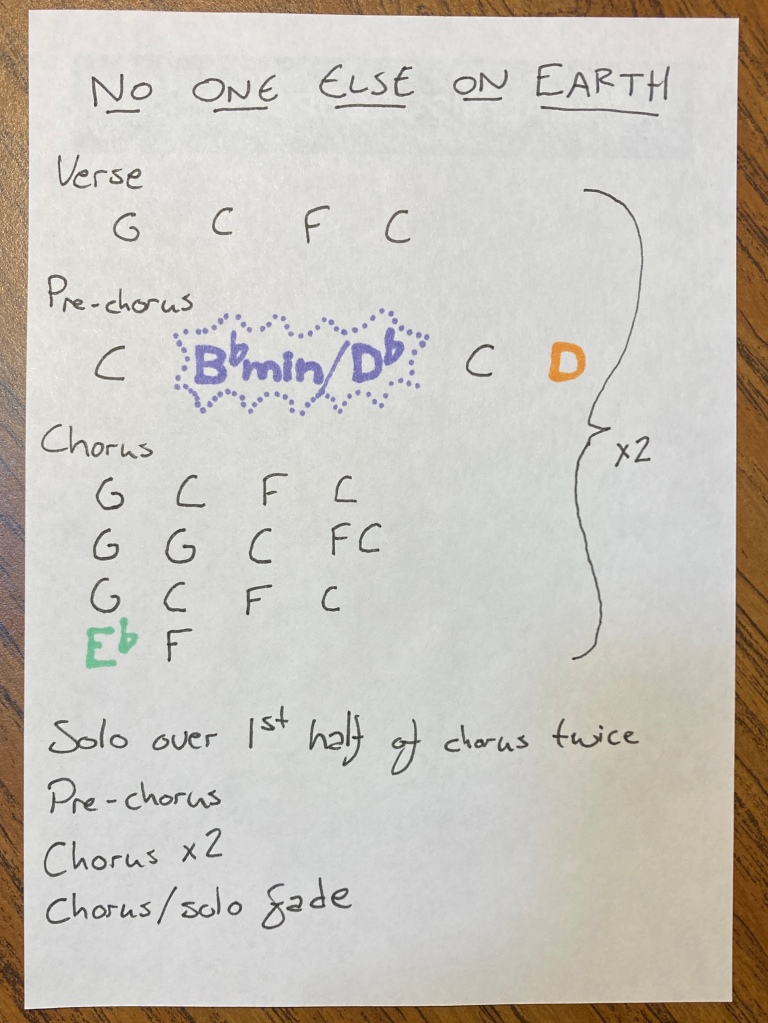
“No One Else on Earth” opens with a very basic chord progression. If you played it on a piano, you’d be using only the white keys. Wynonna is singing about how she fences off her heart, and the music reflects this stable but dull existence.
Then comes the pre-chorus, where love sneaks in under the wire. Two black keys are brought into play—just for two quick beats. In our coloringbook, a boundary has been crossed. But the colorist could not be accused of getting carried away. This is a restrained, surgical transgression.
In fact there are two other places in the song structure where nonstandard chords are used, and for longer durations. But, after that first exquisite stab of chromaticism, they’re not surprising. It’s all part of a design the coloringbook-maker never even contemplated.
The best albums I’ve discovered in the past year or so all came out several years prior. They’re listed in alphabetical order by artist. If these records have anything in common, it’s varying degrees of rough-hewedness. Apparently what my ear has been drawn to lately has not been ProTools perfectionism.
Danny Brown – Atrocity Exhibition (2016)
Sort of the Bone Machine of hip-hop. I listened a few times and decided I didn’t like it — Danny’s nasal delivery and druggy lyrics put me off. But then I couldn’t stop thinking about it. Each time I give it one last chance, I find more to like.
Feist – Metals (2011)
Melancholy, introspective songs with off-kilter, retro production. Dreary but somehow comforting. Perfect rainy day listening.
Low – The Curtain Hits the Cast (1996)
Spellbinding in its slowness and simplicity and scruffiness. It leaves alone a lot of the imperfections that get airbrushed out of most records. The result is intimacy and immediacy. That’s essential: songs this sparse would turn sterile with too much studio intervention.
Tripping Daisy – Jesus Hits Like the Atom Bomb (1998)
I thought of this band as a one-hit wonder, thanks to their 1995 song “Piranha,” which concludes with probably the lamest guitar solo ever recorded. But their overlooked followup album is mature and ambitious. (Hat tip to Talking Heads tribute band Start Making Sense, who turned me on to “Jesus Hits” this fall when they announced they would be covering it.)
Welcome to the first installment of the Zögernd Bookpile, where sounds are summoned from the silence of the printed page.
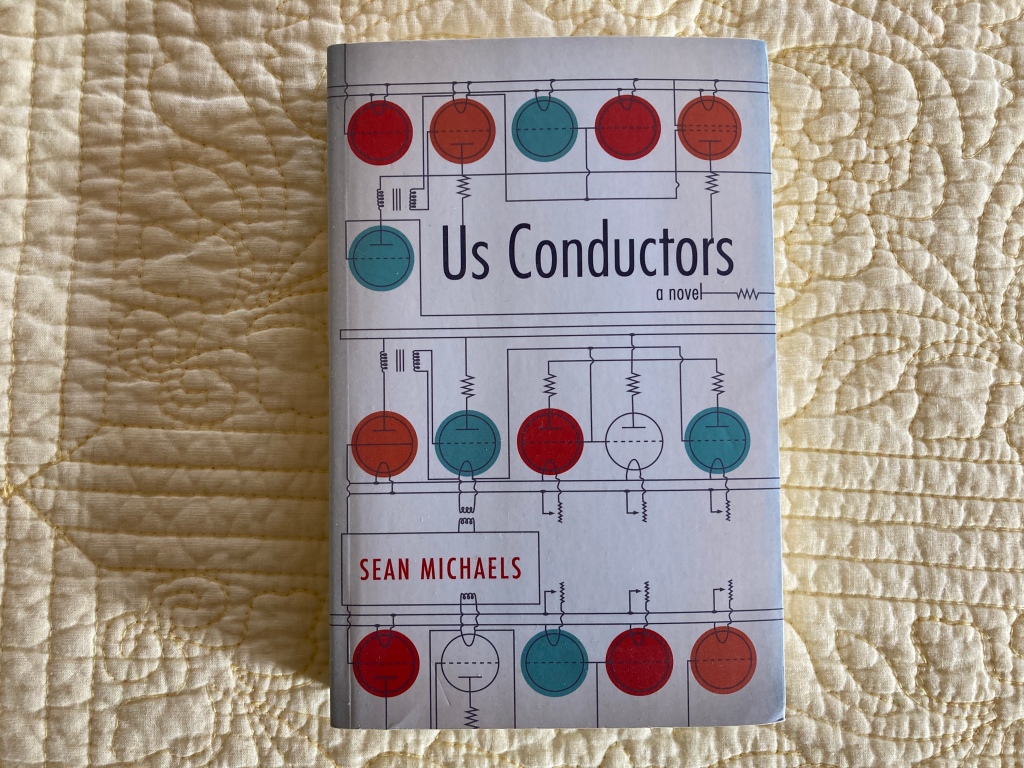
We begin with “Us Conductors,” a 2014 novel that imagines theremin inventor Lev Termen as a reluctant spy for the Soviet Union and practitioner of kung fu. Its subtitle: “In which I seek the heart of Clara Rockmore, my one true love, finest theremin player the world will ever know.”
Given the diagram on the cover, I take the title to be a reference to conductors of electricity — not only the components within the theremin but also the performer’s body, which interacts with the instrument’s electrical field. This performer gestures with both arms to create sounds, a bit like the conductor of an orchestra.
Author Sean Michaels has said the chapter titles in “Us Conductors” are the titles of new wave rock songs of the 1980s — “Music that’s really beautiful and noisy — that was the kind of feeling I was trying to carry through.” With minimal detective work I matched every title to an artist and assembled the following playlist. The only mystery is Part I, Chapter 6: “Closer.” That’s the title of a Joy Division album, but not a song from that band or era or genre, as far as I can tell.
These songs are anachronisms for a book set in the early 20th century. But throughout the narrative are references to several era-appropriate pieces of music — mostly short classical works, a lot of them performed on theremin by either Lev or Clara. Here’s another playlist.
The final composition mentioned in the book is “Bolero” (1928) by Maurice Ravel. My favorite version of this particular piece is done on the Moog synthesizer, a nephew of the theremin.
Joachim Raff’s Sinfonietta ends on a big ol’ F chord, but to me it’s not so fine and dandy.
The uniformity of endings in classical music has been bothering me. Every piece seems to conclude with multiple soundings of the tonic chord. Composers will sometimes dress up these bits of aural clipart with rhythmic flair, but in most cases they stick to the dogma.
For an example, I’ll pick on “Sinfonietta” (1873) by German-Swiss composer Joachim Raff — mostly because I’ve been listening to it a lot since hearing the Holyoke Civic Symphony perform it last fall. The diminutive title is appropriate both for the length of the piece (about 25 minutes) and the stripped-down orchestra of woodwinds and French horns.
Each of the four movements is interesting, but they all conclude in the most predictable way. The first and fourth movements, in the home key of F Major, end with F chords struck multiple times. The third movement, in the dominant key of C Major, puts a C chord through descending inversions before hammering it home. By comparison, the second movement’s ending is adventurous: The tonic chord, F minor, is placed on either side of an outside-the-key C Major chord. Each time I listen, I think, Couldn’t Raff come up with anything better?
I often think back on Arthur Rubinstein’s recording of the scherzo from Frédéric Chopin’s “Funeral March” sonata. The pianist plays the movement’s final two notes in a way that I can only describe as offhand. Is he as bored with endings as I am?





 Zögernd