
Space Demons

The Fully Celebrated Orchestra was a band I idolized in high school and college. I discovered them when a friend took me to a Thurston Moore show in 1999 at MassArt. FCO turned out to be way more interesting than Thurston.
Over the next few years I drove into Boston a ton to see FCO, including one time they were playing in a bar that turned me away because I was underage. “But I just want to see the band,” I protested.
A lot of what I love about about FCO is their frenetic skronking, which isn’t really notatable. But sometimes their tunes do contain something you can put down on staff paper. An example is “Space Demons,” which has always puzzled and delighted me.
 Exhibit A: Transcription of “Space Demons.” Listen here: https://buff.ly/2IFmPHW
The studio version (from “Right On,” 1998) starts with a repeating snakecharmer motif based on the B-flat harmonic minor scale. Suddenly the melody contorts into another plane of existence. Live versions of the song begin in this alternate dimension before settling into the B-flat harmonic minor, then veering off again.
The change follows no scale or chord progression I can identify. Alien as it sounds, though, it does seem to follow some internal logic.
The title may be a reference to a 1985 young adult sci-fi novel where the protagonists get sucked into a video game “Tron”-style. One moment you’re on terra firma, the next you’re in uncharted territory trying to escape demons from space.
Lyrical ADD
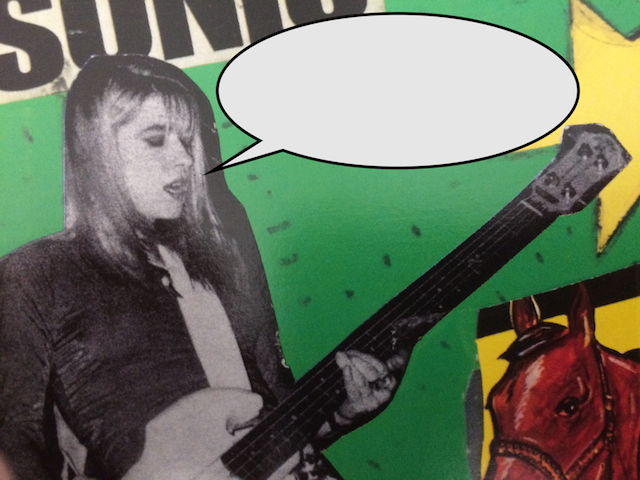
I was telling a date in college about my desire to form a band to cover Sonic Youth’s “Tunic (Song for Karen)” (from “Goo,” 1990). Turned out years earlier she’d written a paper about the song. “What about it?” I asked. The pretty-obvious-now-that-I-think-about-it answer was anorexia. The Karen in the title is Karen Carpenter, who struggled with the eating disorder throughout her music career and died at 32.
If I had written a paper about that song, it would have been about the desperate guitar chords and the Morse code bassline. The lyrics, and especially their meaning, probably would not have come up.
And now this blog turns confessional as I admit my blackest shame: I’m not a lyrics person.
My excuse is that there’s so much else to hear. Obviously sometimes a word, phrase, or anthemic chorus will register. But usually my attention gravitates instead to details like recording fidelity, harmonic choices, elements of the rhythm or percussion, or simply the texture of the singer’s voice as opposed to the content of their lyrics. Languageless sound is, to me, an infinitely shinier object.
I know I’m missing out. On a lot. But as soon as I start concentrating on what’s being sung or following along with a lyrics sheet, my in-the-moment enjoyment of the music is squelched.
There are those who prefer instrumental music. For some people a cappella is the thing. There’s a saying that nobody listens to the words in rock songs anyway. But are there listeners out there who hear only the lyrics and deprioritize or even tune out the instruments, the notes?
Does anybody put music and lyrics on truly equal footing?
Coda:
The band that would have covered “Tunic” also would have played The Supremes’ “You Keep Me Hangin’ On” (1966). I always felt there was an aural kinship between the two songs. Perhaps subconsciously I was getting the anorexia message after all. Diana Ross wrote in her autobiography that the stress of working for Berry Gordy led to her eating disorder.
Basement orchestra
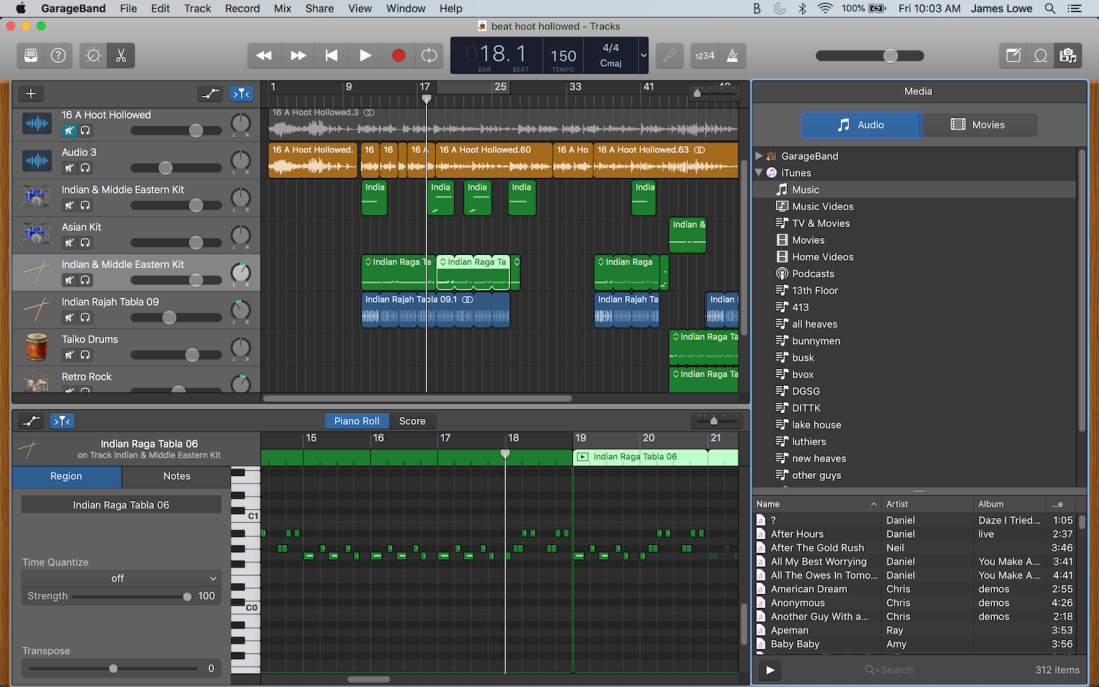
Exhibit A: A GarageBand drum sequence in progress.
Rolling Stone has a fascinating read about GarageBand on the occasion of its 15th birthday. Fascinating for me, at least, because I use the software every single day. Mainly as a practice tool: Rather than use an amp at home, I plug my bass into my laptop and listen to myself on headphones. This makes it very easy to play along with songs and demos, and especially to record and listen back to myself as a way to better understand and improve my performance. (Practice via self-recording is a key takeaway from one of my favorite blogs, by the opera timpanist Jason Haaheim.)
The thesis of the Rolling Stone article is that GarageBand has democratized music by making the means of production accessible to the masses, but that this has come at the expense of music becoming more homogeneous. My take: Sure, a lot of people, including pop stars, can and do use the loops that come prepackaged with the software. But stock loops are just the beginning. GarageBand lets you create so many of your own sounds, and the palette is expanding all the time.
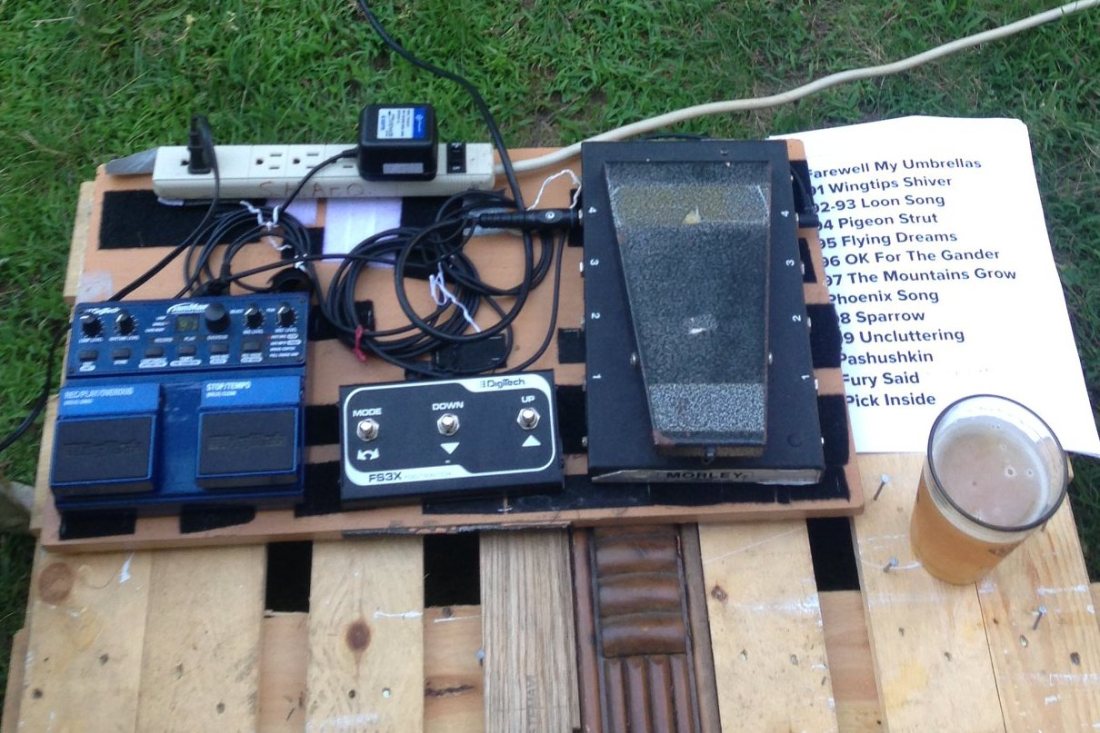
Exhibit B: Susanne.
My band has been without a full-time drummer for a few years now, but rather than let that bum me out I decided early on to use GarageBand and our trusty JamMan loop pedal to make a substitute. I’ve gotten pretty good at building backbeats and fills, blending available drum samples and nudging beats ever so slightly off the grid to make what comes out sound almost like it was played by a real person on real wood, aluminum and polyethylene terephthalate.
We call our robot drummer Susanne. She never drops a stick and she never speeds up or slows down (unless we tell her to). She’s enabled us to keep up the high-volume rocking even in the absence of someone bashing a kit. Only trouble is, if we mess up, she can’t adapt.
Exhibit C: A template.
Exhibit D: A reconstruction.
Creating Susanne’s beats, I started pretty simple. Eventually I got a little obsessive recreating the performances of human drummers we’ve played with over the years. Sometimes I brought in other instruments — from pianos and synths to tablas, taiko drums, and a Persian santoor — to flesh out the backing tracks. GarageBand became my basement orchestra.
Perfecting all this audio down to the smallest detail was very satisfying for the Aspergian side of my brain. On the other hand, spending hours making microadjustments would always give me a megadose of self-loathing.
Nowadays, for my sanity’s sake — and thanks to the realization that my simulacra will never sound “real” — I’m working in another direction. These new percussion sequences ought to embrace their artificiality. I’m still figuring out what that means and what it sounds like.
As to the notion that GarageBand constrains music? The opposite has been true in my experience.
indie Rxock

Moderate to severe Crohn’s disease and back pain threaten to keep two hip, young frontwomen from the spotlight. Only after they’ve popped some pills can the show go on.
It’s a riff as old as rock ‘n’ roll.
Most drug commercials have main characters — and presumably also target demographics — around middle age. But two ads in heavy rotation today prominently feature twentysomething indie rockers. Why the aberration? Part advertising industry co-optation of youth culture, part Big Pharma setting its sights on a new generation of consumers.
Both spots must’ve cost small fortunes to produce. There are multiple locations, including outdoor festival stages, a music hall, a recording studio and a tour bus. There are gaggles of extras to populate the concert crowds. And there’s loads of genuine musical equipment, including several auxiliary instruments that merely decorate the stage. The guitarist in the 60-second “Not Always Where I Needed to Be” ad for Humira plays what looks like Jerry Garcia’s Doug Irwin Tiger, but with a tapered headstock.
The 15/30-second “Rock On (And On and On),” promoting Aleve, even features indie music, sort of. The backing track is “Give It Up” by Sarah McIntosh, who was affiliated with commercial music group The Den, which described itself as “home to a specially curated roster of independent artists who craft original music for visual stories. Our talented artists collaborate in order to create a more informed and original catalog with the highest production integrity.”

Older rockers are a bit of a trope in drug commercials.
One for the blood thinner Eliquis is set at an outdoor concert and has a few extra prop guitars, just like the Humira and Aleve spots. But instead of a young woman, its protagonist is a silver-haired dude who says, “I accept I’m not 22.”
A Xarelto ad features a guitarist and singer staving off stroke long enough to play at least one more wedding with his band. An epic 90-second spot for the diabetes drug Ozempic corrupts Pilot’s “Oh Ho Ho It’s Magic” and features among its three story lines a singer with an old-timey microphone at a classy soiree.
And of course there are the ads for Cosentyx featuring psoriasis sufferer and real-life ’80s rockstar Cyndi Lauper.
Another drug commercial featuring indie rockers: Biktarvy TV Spot, ‘Keep Being You’
Trompe l’oreille
Pop music depends on rhythmic expectations. Sometimes an artist will deliberately mess with those expectations. Other times the way you hear things will be misguided.
This happens sometimes when you turn on the radio in the middle of a song. Suddenly what the musicians think of as an upbeat you hear as a downbeat, or vice versa. Take for example this clip that starts a split second after the song does.
The rhythm guitarist seems to be playing 1 2&3 4&. The lead guitarist seems to be playing on the ands of 1 and 3. But when the drums come in something’s weird. Turns out you’ve been hearing it all wrong. The rhythm is syncopated, and the lead is playing downbeats.
The first two songs on Les Savy Fav’s “Root for Ruin” (2010) do this to me every time.
“Appetites” starts with a misleading countoff that makes me wonder if the rhythmic disorientation isn’t intentional. The guitar motif sounds for all the world like it starts on the 1. The drums are doing something unconventional, but nothing to persuade me I’m wrong. This rhythm sense persists when the bass and vocals join in. It persists right up to the B section (0:38), where now it’s clear I was mistaken.
Exhibit A: Song starts on a downbeat.

Exhibit B: Song starts on an upbeat.

“Dirty Knails” fools me for even longer (until the chorus at 1:11), with the whole band landing hard every bar on what I can’t help but hear as the 1. But I’ve been an eighth note behind the whole time — it’s actually the and of 4.
Even if I start the songs over, I can’t hear the syncopation without assistance. Which is both frustrating and kinda neat. We’re so used to hearing snare on 2 and 4, it’s refreshing to hear it somewhere else.
Does this happen to you? Send examples. One more I’ve found is “I Follow You” by Melody’s Echo Chamber, although there the spell is broken as soon as the drums start.
Mixed messages

A girl gave me my first mixtape in high school. On a real cassette. Actually it was all of David Byrne’s “Uh-Oh” (1992) with “What I Like About You” and other songs added on the leftover tape.
Then there was the tape I never gave that girl from my summer internship. It started with Fugazi’s “Do You Like Me.” Asinine.
Over time the subtext of the mixes I gave and received modulated from romance to respectability. Friends introduced me to pivotal material (The Dismemberment Plan’s “Memory Machine,” the Persuasions’ cover of “Man in Me,” The High Dials’ “Desiderata”), while I tried to get others excited about XTC, Chicago, and Medeski Martin & Wood.
In modern times I exchange mix CDs with a friend at the end of every year. All year I’m assembling playlists of candidate songs that, starting around Thanksgiving weekend, get juxtaposed and winnowed until the perfect mix emerges. All this preparation is done in anticipation of receiving a CD that’s just as carefully curated.
There’s still a hint of that ulterior motive; at the very least there’s a little friendly competition going on. Each creator wishes to have found the most obscure gem, or to have demonstrated the most legit taste.
There’s at least a little altruism at work here too: the desire to expose others to worthwhile music. But following any exchange comes anxious anticipation. Will others see my darlings as I see them? Will anyone remark on them?
There’s much to be said for placing a familiar favorite at just the right spot. But the real excitement is in the unknown, and the new favorite songs or albums or bands hiding there.
For this reason my policy is to withhold the tracklist. The listening experience ought to be free of any prejudices the listener may have formed about a band whose name they recognize. The song titles should not make an impression before the sound itself does. Only once a recipient has satisfied me that they’ve listened carefully do I divulge my secrets.
That said, the contents of Spotify playlists are not anonymous, and I want to share one here. You may listen only if you promise to keep the openest of minds.
A note about my nom de mix: DJ Welfare Mockeries is the weirdest anagram I could make out of my name. I would never mock welfare or its recipients.
Prelude
This will be a blog not so much about music as about everything around music. Perceptions and impressions. Emotions, ideas. Tangents.
It won’t be reviews or criticism per se, although sometimes I might write about shows I went to years ago or albums that came out decades ago.
It won’t be about musicians or their craft, necessarily. I may interview a musician here or there. From time to time I might transcribe a melody or chart a chord progression that strikes my fancy.
It won’t be scientific, but it will have a lot to do with hearing and perception. There are fascinating differences in how music is consumed, experienced and remembered from listener to listener.
While I will certainly make recommendations, I also will resist snobbery. Perhaps somewhere there’s an antidote to the oneupmanship and shaming that so often infects our conversations about music.
About the title of this blog: In musical notation, zögernd means to play hesitantly. That is how I plan write — without much certainty even after much reflection.
 Zögernd