It amazes me when I see co-workers sitting at their desks, typing away, with earbuds in. Doesn’t the music distract them from their work?
Or vice versa — doesn’t doing something else detract from the listening experience?
I usually can’t help but give music my full attention. Except for the most ambient music, I find I can’t concentrate on any other task (say, blog writing) if there’s music playing. As such I do most of my listening at times of relatively low CPU usage, so to speak, like when I’m driving or folding laundry.
But seldom do I listen to music to the exclusion of all other activity. That is, I don’t just sit in a chair and let a record play. My mind starts wandering. I need to be fidgeting with something or avoiding potholes. (Live music is different: You can watch the band, you can watch the crowd.)
Long ago I had a friend who would put on the TV, cue up a record and open a book. He also did a lot of Ritalin. His is an extreme case, but I’m interested in how far others are able to divide their attention when music is involved. Is being able to listen while doing other things an innate ability, or a habit that can be cultivated (or broken)?
If I’ve held your attention this far, tell me how it works for you.
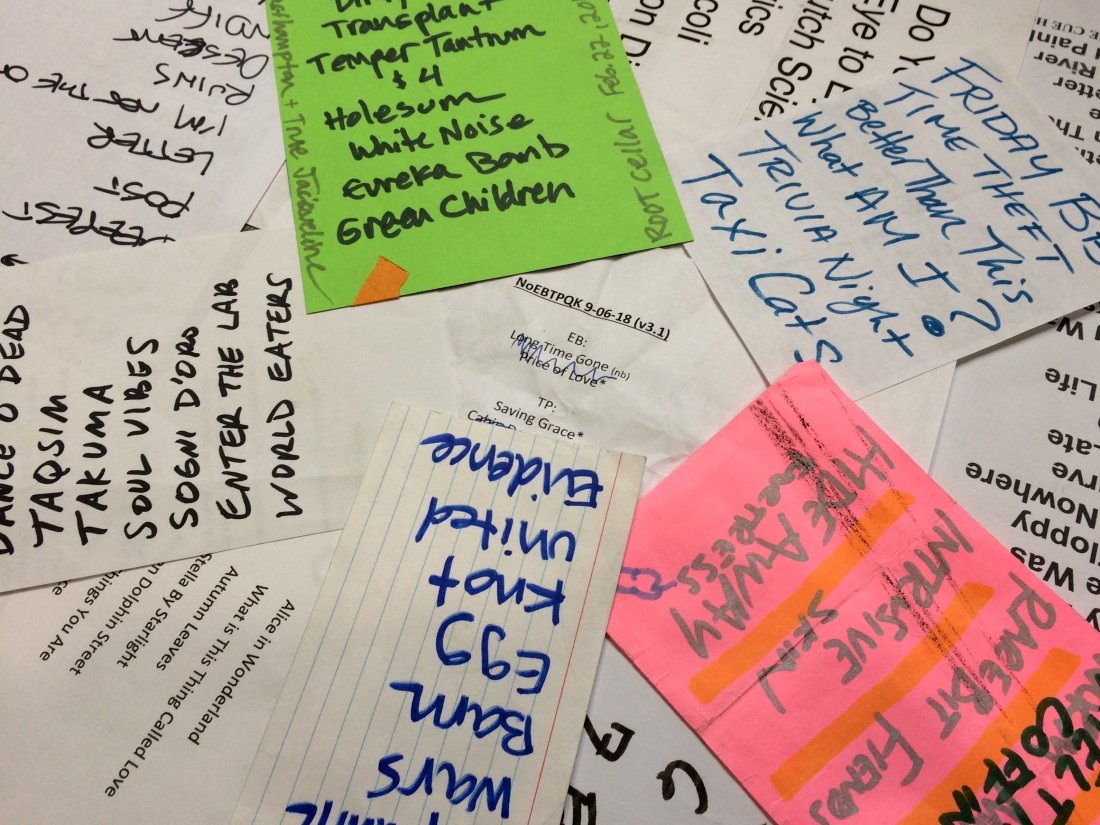
Printed on 8.5×11 or scribbled on a napkin. Painstakingly constructed or thrown together at the last minute.
Musicians’ setlists fall into two basic categories that could be said to align with Freud’s concept of anal fixation.
They can be faithful pre-creations of a performance, or merely a jumping-off point. They may list actual song titles or the performers’ pet names for songs. They can get pretty involved as far as font selection and stage directions.
The truly professional or daring or carefree call out songs as they come to mind, no need for an agenda. But it can always be written down afterward.
The setlist’s Platonic ideal is the album track listing, which is an itemized receipt not only for rehearsal and preparation, but also the extermination of mistakes and awkward pauses.
For some musicians a setlist is a locus of anxiety. It’s a treasure map, but one that implies every unseen pitfall. A flight simulator that actually takes off.
Presumably it’s different for those on the expulsive side of the equation.
But all musicians crave validation; they may even settle for acknowledgement. If the gig is the service rendered, then the setlist is the documentation: an invoice, a timeslip, a W2. Redeem this coupon at checkout for half off obscurity.
There’s a challenge going around Facebook that asks users, over 10 days, to post the covers of 10 albums that influenced them. To put my own obnoxious twist on it I did back covers, in reverse alphabetical order by title of the closing track. And you’re not supposed to do reviews, but I did reviews. And tweeted them.
1. The Streets – Original Pirate Material (2002)
DIY orchestral rap by a white guy from London? At first my enjoyment of this album was probably ironical, but it would have ceased to be so by about the dozenth time my roommates and I put it on. This is legit, and there’s real pathos here.
2. Field Music – Tones of Town (2007)
Genteel string arrangements alongside bass fuzz and a synthesizer riff straight outta Dr. Dre. Lyrical themes of impermanence on top of songcraft and recording perfectionism meant to be enduring. Pop that knows it’s smart and invites you to feel smart for enjoying it.
3. Liars – Drum’s Not Dead (2005)
This band started out with some excellent dance-punk records, then decided to go conceptual and weird. Primitive drumming, imprecise loops, out-of-tune guitars droning and blasting noise, mostly falsetto singing. Great for zoning out in the dark and imagining you’re high.
4. Medeski Martin & Wood – Friday Afternoon in the Universe (1995)
I can hum every solo, bass run, drum fill and group improvisation — to give you an idea of how many times I listened to this as a teenage music snob. I like most of what MMW did subsequently, but here the vibe is so specific. It sounds deep maroon, just like this back cover.
5. Ben Folds Five – Whatever and Ever, Amen (1997)
In hindsight, this album is a lot. Goofiness contrasted with melodrama, male solipsism and casual misogyny alongside tenderness and longing. Those three-part harmonies. A rock band led by a piano, for chrissakes!
6. Sonic Youth – Screaming Fields of Sonic Love (1995)
A compilation, if not strictly an album. Crucial in my initiation into SY, nonstandard tunings, merging new ideas of songforms and freedom. Also a gateway drug into noise and free jazz.
7. XTC – Skylarking (1986)
The story is well known how “Dear God” was dropped from the original release because it was considered too controversial. Then they put it back, and dear god, the track that got bumped, “Mermaid Smiled,” is a goddamn masterpiece, a microcosm of this perfect record.
8. Talking Heads – More Songs About Buildings and Food (1978)
A record that a shy teenager could be forgiven for believing is about him. Clinical descriptions of social awkwardness, accompanied quirkily. As for influence: Where would I be as a bass player without Tina Weymouth and “Found a Job”?
9. Mates of State – Our Constant Concern (2002)
There’s the mystique of the adorable couple having intimate conversations through lyrics no one else has the context to decode. Bonus: the hokey awesomeness of the Electone. If this can be indie rock, anything can be indie rock.
10. Fugazi – The Argument (2001)
I just didn’t get this one for a long time, couldn’t reconcile it with their past work. But once it clicked, I understood that any music that didn’t immediately jibe with my sensibilities was music I should pay closer attention to.
* Concise Historical Impression of a Recording or Performance.
This time of year it’s de rigueur for music critics to proclaim the best albums to emerge during the prior 12 months. I listen to plenty of new-to-me music in the course of a year, but not all of it is in album format, and very little is new releases. So here are some music collections, discovered within the last year (or three), that have delighted me end to end. Entries are alphabetical by artist.
Blind Melon, “For My Friends” (2008)
The band’s best work, which may be a sacreligious opinion given that it’s post-Shannon Hoon and that the replacement singer is trying to sound like Shannon Hoon.
Busdriver, “Thumbs” (2015)
The most idiosyncratic rapper. Amazing feat.s. Mind-altering production.
David Byrne “Uh-Oh” (1992)
A rediscovery. I expected to find it mildly diverting, but it turned out to be super solid and fun.
Cibo Matto, “Hotel Valentine” (2014)
Curious, squiggly, glitchy sounds woven into songs that are by turns dancey and spooky. Another awesome band that went away for a little while then came back awesomer.
The Move, “Shazam” (1970)
Heavy psych rock with proggy twists and turns, including a detour into Bach and Tchaikovsky.
Rhye, “Woman” (2013)
Warm synths and understated grooves and that smooth, androgynous voice. Only problem is you can’t properly listen to this one anywhere the light is bright.
Esperanza Spalding, “Emily’s D+evolution” (2016)
A pretty rockin set from someone I thought of as more of a jazz artist. Some of the playing is a little showoffy but the songs are beautifully crafted and full of earworms.
The True Jacqueline, “An Adventure Somewhere Maybe” (2019)
Tommy Boy released this magnificent 12-CD compilation in 2005 and 2006. Obnoxiously, all the cuss words are digitally reversed (i.e., censored). But all the best old-school stuff doesn’t have any cussing anyway.
John Waters’ “Hairspray” (1988) is a favorite film for a lot of reasons, not the least of which is the eponymous song that plays over the opening and closing credits. It’s a ’60s homage propelled by that sine qua non of ’80s pop — tons of gated reverb on the snare drum.
The song itself is simple as can be. Key of C, modulates up a wholestep at the end, verse follows a I-iii-IV-V chord progression. “Let me tell you ’bout the latest craze,” Rachel Sweet sings over the bright tonic chord (C Major), then a minor chord (E minor) creates tension: “Mama’s hoping that it’s just a phase.” But she escapes back to positivity (F Major): “But I know it’s gonna last forever,” and reinforces her triumph with the dominant chord (Gsus4 to G Major) while singing, “You’ve gotta see the way it keeps my hair together.”
The chorus uses the same chords, except the vi chord (A minor) is substituted for the iii. Layered on top of the first three chords are backup singers repeating the word “Hairspray,” with one singing the root (C) and the other the fifth (G). This takes us out of the realm of basic triads and into upper extensions, effectively making the chord progression C Major / A minor 7 / F add 9 / G Major.
“Hairspray” is a nostalgia film, and this is the harmony of nostalgia, with the fundamentals of the scale staying the same even as the chords change around them.
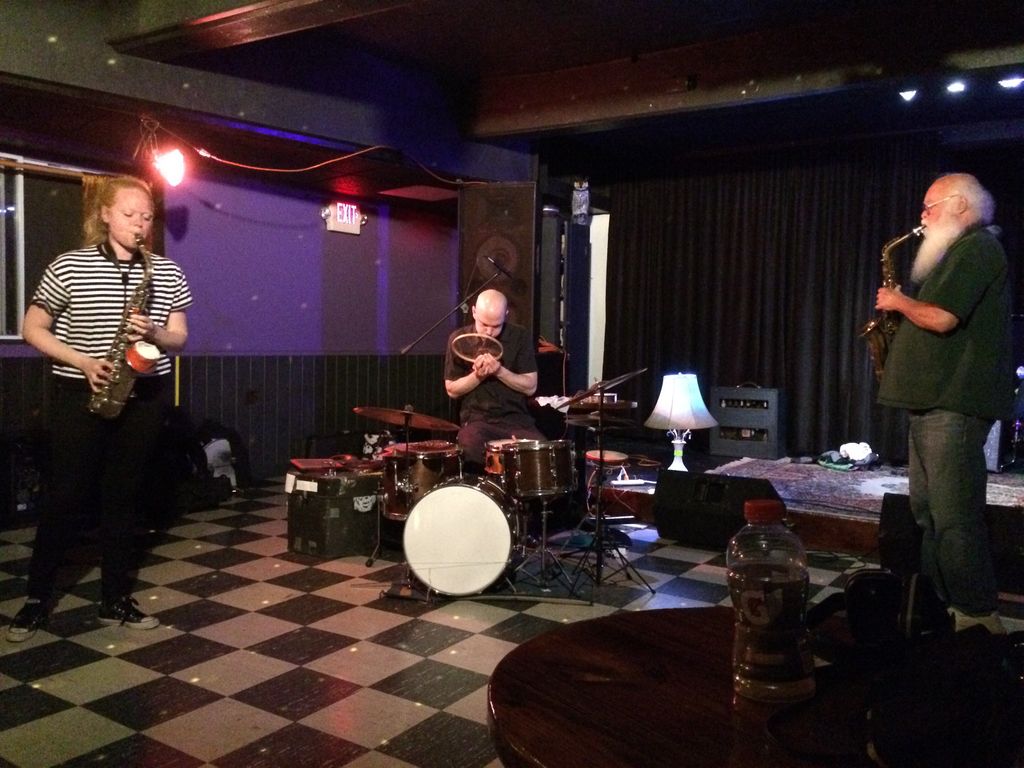
When Paul Flaherty’s at home, does he practice scales? Is he ever caught humming familiar melodies? Does he ever play old favorites in the town band down at the gazebo?
(Mette Rasmussen/Chris Corsano/Paul Flaherty at the Root Cellar, Greenfield, Mass., 6/21/19)
* Concise Historical Impression of a Recording or Performance.
There is music we believe we shouldn’t like, but we do.
Between the individual and their peer group there is a negotiation of borders, the mutual drawing of a dotted line around cultural products acceptable to consume. It’s malleable and porous, but it is a boundary.
Shame manifests when we sneak out through one of the gaps. If we don’t self-censor, we self-censure; we envision the ridicule of our peers.
Brought up on punk, XTC’s Andy Partridge secretly fell in love with a delicate folk record, Judee Sill’s “Heart Food” (1973). As he wrote in the liner notes for the album’s 2005 reissue, when no one was around he would listen to it with “almost masturbatory guilt.”
Almost. One doesn’t have to be quite so discreet with forbidden music, listening on headphones or in the car where others can see but not hear.
Such secretive listeners find virtue where vice is imagined; and so some become exhibitionists. They cross the line — maybe with a touch of irony to be safe. Thus I flaunt some of my guilty pleasures:
Amy Grant, “Baby Baby” (1991)
Grant wrote it about her actual infant, but passed it off as a song about grownup love, so maybe it’s a little purer than your average. Also the arrangement and instrumentation are unmistakably influenced by one of my most favorite albums, Scritti Politti’s “Cupid & Psyche ’85.”
Gwyneth Paltrow & Huey Lewis, “Cruisin'” (2000)
One of the must’ve been three songs that played in a loop when I worked at the grocery store. It’s the one that wore me down. Didn’t learn until much later that it’s a Smokey Robinson cover. This recording was a No. 1 hit, far outshining the film it came from, “Duets.” Just listen to the song and it’s lovely. Don’t think about the fact it’s being sung by characters who are father and daughter.
Taylor Swift, “I Wish You Would” (2014)
Blame my daughter for this one. Through many, many plays of “1989,” this is the track I looked forward to. The chorus is especially potent, with its growling bass, drum cannonade, and synth effects like the clang of swords in a Nintendo game. This song was never released as a single and only charted in Canada. Does falling for a Tay Sway deep cut mean I’ve still got some cred?
No one better have recorded Hot Dirt playing at the Sierra Grille last week. Those sounds existed to disappear and if you missed them too bad. Putting them on tape would be like unwithering a flower. Just because you can do a thing doesn’t mean you should.
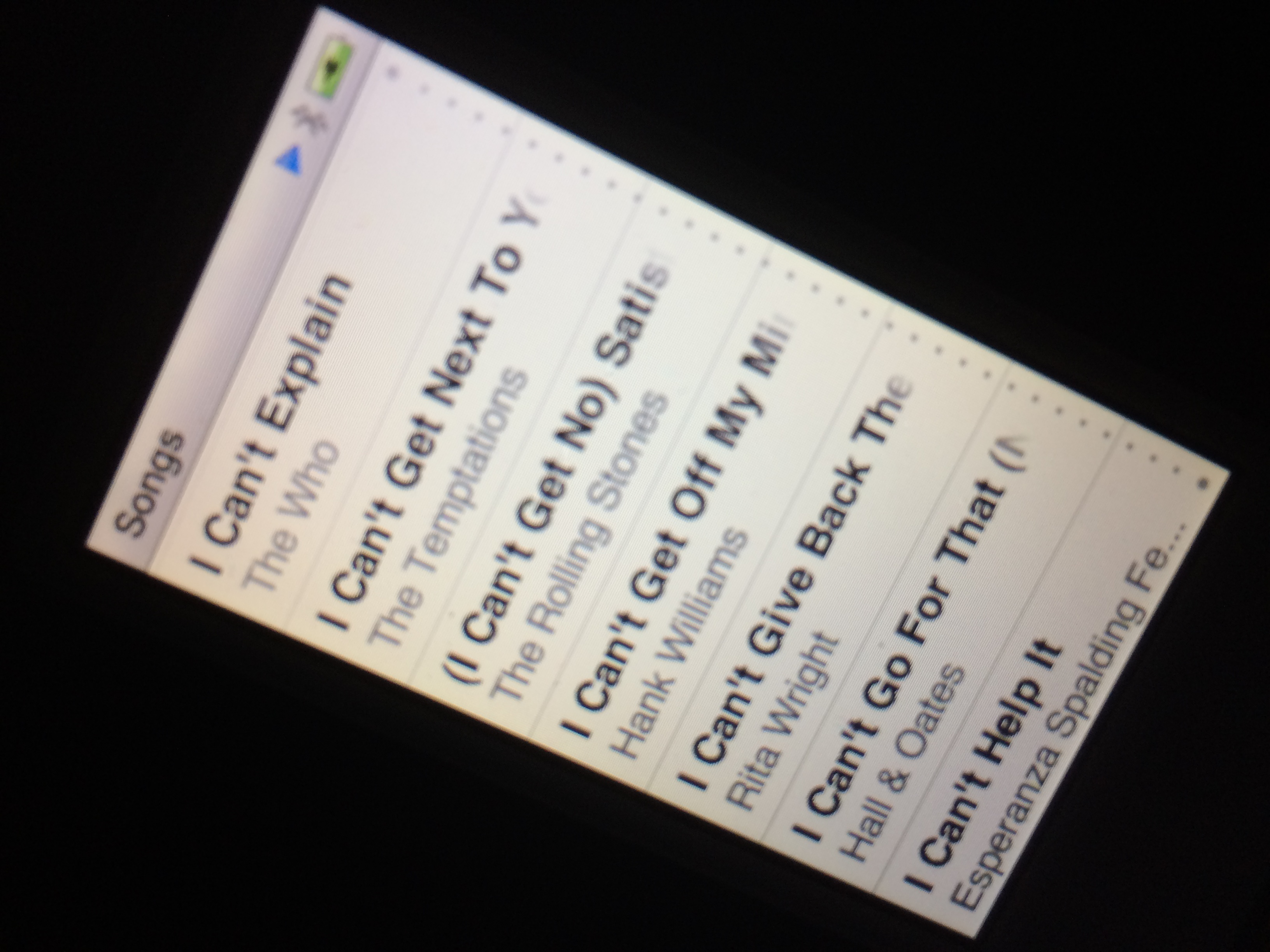
The shuffle function on my iPod never seemed to do that great a job at giving me variety. Not that I really minded hearing two Neko Case songs in a row now and then, but I felt it could do better.
One day I hit upon the idea of listening to the iPod’s contents in alphabetical order. This succeeded in randomizing selections in a more satisfying way and had some lovely unintended consequences.
Organizing by title can produce runs of songs that sound wildly different but share thematic material — see for example the group of “I Can’t” songs that deal with the more frustrating aspects of being in love.
Listening in alphabetical order can also give you multiple versions of the same song back to back. Provided your library is comprehensive enough, you can trace the song’s evolution from artist to artist, or even from demo to studio to stage (though not necessarily in that order).
This is as good a substitute as I’ve found for the excellent but apparently defunct podcast “Where’s That Sound Coming From,” each episode of which focuses on a single song through the lens of a dozen or more covers, with lots of research and interesting anecdotes about the performers mixed in.





 Zögernd