Undermining my own humble efforts around standalone bass guitar music are rock bands that eschew the instrument entirely.
Utter depravity, I say. A band without a bassist is like a body without a brain.
First let’s take bands that, while they may not have a literal bass, use other instruments to fill the role of a bass. Prime example: Keyboardist Ray Manzarek of the Doors played high sounds with his right hand and low sounds with his left. On studio recordings, the Doors sometimes enlisted a proper bass player. Clearly they recognized what was missing.
Other bands are not so apologetic. Petulantly, they don’t even try to fill the void left by the bass’s absence.
A devil’s advocate might assert that there’s something special in the intimacy, the immediacy of the bassless rock duo. These skeptics might point to the White Stripes and say that to add a bassist would be to subtract from the magic. Such sonic sophistry is easily dismissed.
There are of course larger bands without bass — ones that have even less of an excuse for their exclusivity. Could anyone argue that the treble-only music of Sleater-Kinney or the Yeah Yeah Yeahs has any heft whatever? Not with a straight face.
True extremists attempt to call the bass obsolete. So much music listening today, they observe, is done on cellphones and tiny earbuds — devices too small to convincingly render the deepest aural frequencies. Why, this argument goes, should anyone bother recording sounds that will never be heard?
All nonsense, certainly. Bass isn’t just something you hear with your ears, it’s something you feel with your whole body. It’s fundamental. Isn’t it?
What follows is a partial list of bands with bass. Send additions to zogernd [at] gmail [dot] com.
Decades of popular music have conditioned us to expect every song’s title to correspond to words from that song’s refrain. We can see the lyrics confer authority upon the title just as the title substantiates the lyrics.
But from time to time we witness a breakdown in this reciprocity. When there isn’t an exact match between title and lyric, we may be puzzled, or amused, or confounded.
There are plenty of cases where the title bears zero resemblance to the lyrics — or even their subject matter. Classic examples are The Who’s “Teenage Wasteland,” which is actually called “Baba O’Riley,” and Bob Dylan’s “Everybody Must Get Stoned,” which is officially known as “Rainy Day Women #12 & 35.” The catalogs of the Beatles and the Monkees are shot through with songs possessing this kind of dissociative identity disorder.
Odd as they are, however, such incongruous titles don’t contradict the songs with which they’re associated. They merely stand apart. And by standing apart so conspicuously, the black sheep is bound all the more tightly to the flock.
More intriguing are songs where title and lyric are similar but not quite the same. In these instances, the definitive version does not exist. Neither title nor lyric can be deemed correct or incorrect. All we can do is sit back and and watch them bicker.
While many examples of mismatches follow below, special distinction belongs to “Na Na Hey Hey Kiss Him Goodbye” by Steam (1969). The title isolates the song’s distinctive non-lexical vocables and other keywords, respecting neither their number nor their sequence. Meanwhile, the song has followed a remarkable trajectory. While it began as the pleadings of a jealous voyeur, its chorus has become the universal chant used to belittle athletic failure. Its recognizability has long eclipsed its awkward title.
Discrepancies between title and lyric may be superficial or significant, and they may happen for practical, whimsical, or unintentional reasons.
While lyricists’ imagination and tendency to obey meter may yield extended phrases — and although these extended phrases may be very catchy or memorable — commercial interests often demand concision. In other words, a shorter title is usually more practical than a longer one.
Practicalities of intellectual property, branding, and polite society must also be observed. There may be an interest in avoiding titles that are controversial1 or duplicative of recognizable songs of the past.
Of course the decision to shorten a title may be totally impractical. People like to abbreviate and use pet names. Sometimes the informal moniker is recorded on the birth certificate.
Lastly, unintentional alterations of the title are a possibility, especially on pre-digital printed materials like record sleeves. Typographical errors and other careless mistakes are bound to happen.
There are a couple examples of mismatches being reconciled. One holiday staple started out in 1951 with a simplified title, but subsequent releases include the full phrase: “It’s Beginning to Look a Lot Like Christmas.” A 1955 Fats Domino single was initially labeled “Ain’t It a Shame,” but later became “Ain’t That a Shame,” matching what was sung.
Whatever their cause, mismatched titles generally present in seven forms. What follows is an ever-expanding list of examples. I’m greatly indebted to members of the Steve Hoffman Music Forums who identified several qualifying entries in 2009. Send additions to zogernd [at] gmail [dot] com. Bonus points if you can find an example where the title is wordier than the lyric.
1. Loss of specificity
By Fire — Hiatus Kaiyote (2015)
Lyric: Direct to the old Navajo by the fire Discussion: The title calls to mind a metaphorical trial by fire. But in the song it’s a literal campfire.
The Same Does Not Apply — Rustic Overtones (2009)
Lyric: The same does not always apply
Another Day In Paradise — Phil Collins (1989)
Lyric: ’Cause it’s another day for you and me in paradise
Living for the City — Stevie Wonder (1972)
Lyric: Living just enough, just enough for the city
Won’t Get Fooled Again — The Who (1971)
Lyric: Then I’ll get on my knees and pray / We don’t get fooled again Discussion: There’s a world of difference between praying not to get fooled and being foolproof.
What Is Life — George Harrison (1970)
Lyric: Tell me, what is my life without your love?
She’s a Rainbow — The Rolling Stones (1967)
Lyric: She’s like a rainbow Discussion: The title is a metaphor. The lyric is a simile. Maddening.
Don’t Talk to Strangers — The Beau Brummels (1965)
Lyric: Don’t you go talking to strangers Also: Don’t you dare go unto strangers And: Don’t you go runnin’ to strangers
I’ll Feel a Whole Lot Better — The Byrds (1965)
Lyric: And I’ll probably feel a whole lot better when you’re gone Discussion: The title declares, but the lyric equivocates.
(You’re My) Soul and Inspiration — The Righteous Brothers (1966)
Lyric: You’re my soul and my heart’s inspiration
2. Omission of intensifiers
We Are Never Ever Getting Back Together — Taylor Swift (2012)
Lyric: We are never ever ever [ever] getting back together Discussion: Both Taylor and Bryan Adams (see below) employ repetition in their lyrics to eliminate ambiguity. Their titles delete the duplicate words, but still end up being fairly long.
Have You Ever Really Loved A Woman — Bryan Adams (1995)
Lyric: So tell me have you ever really, really, really ever loved a woman
They Don’t Care About Us — Michael Jackson (1995)
Lyric: All I wanna say is that they don’t really care about us
Blame It On Your Heart — Patty Loveless (1993)
Lyric: Blame it on your lyin’, cheatin’, cold, dead-beatin’, two-timin’, double-dealin’, mean, mistreatin’, lovin’ heart Discussion: This string of accusatory adjectives would’ve taken a week to scroll across your iPod screen, but the more economical title hardly captures the spirit of the song.
Boom! Shake the Room — DJ Jazzy Jeff and the Fresh Prince (1993)
Lyric: Boom! Shake, shake, shake the room
I Really Love You — The Stereos (1961)
Lyric: I really, really love you
3. Simplified pairings
Hot N Cold — Katy Perry (2008)
Lyric:Cause you’re hot and you’re cold
Love/Hate — Liz Phair (2003)
Lyric: It’s a war, all the love and hate
Alone + Easy Target — Foo Fighters (1995)
Lyric:I’m alone and I’m an easy target
Right Place Wrong Time — Dr. John (1973)
Lyric:I was in the right place, but it must’ve been the wrong time
Sunshine Superman — Donovan (1966)
Lyric: Sunshine came softly through my a-window today Also: Superman or Green Lantern ain’t got a-nothin’ on me
4. Substitution
Off He Goes — Pearl Jam (1996)
Lyric:There he goes with his perfectly unkempt clothes/hope
What’s Up — 4 Non Blondes (1992)
Lyric: And so I wake in the morning and I step outside / And I take a deep breath and I get real high / And I scream from the top of my lungs, “What’s going on?” Discussion: The possibly apocryphal story goes that the San Francisco band’s breakthrough was retitled because Marvin Gaye already had a hit in 1971 with “What’s Going On.”
Other Arms — Robert Plant (1983)
Lyric:Lay down your arms
Young Turks — Rod Stewart (1981)
Lyric: Young hearts be free tonight Discussion: The official title captures the protagonists’ rebellion but not their romance. The lyric is awfully similar to Candi Staton’s 1976 disco hit “Young Hearts Run Free.”
Open the Door, Homer — Bob Dylan & The Band (1975)
Lyric: Open the door, Richard
Gimme Little Sign — Brenton Wood (1967)
Lyric: If you do want me, gimme little sugar Also: Just gimme some kind of sign, girl
5. Contradiction
Without You — Pugwash (2017)
Lyric: What did you do all day without me?
Jesus Wants Me For A Sunbeam — The Vaselines (1992)
Lyric: Jesus don’t want me for a sunbeam Discussion: Nirvana made this song famous with their “MTV Unplugged” cover, retitling it “Jesus Doesn’t Want Me For a Sunbeam.” The Vaselines sing “Jesus don’t want me,” but their title asserts the opposite. However, in the 2009 live version above, they introduce the song using the “Doesn’t” title. The song parodies a children’s hymn called “I’ll Be a Sunbeam.”
Strawberry Letter 23 — Shuggie Otis (1971)
Lyric: A present from you, Strawberry Letter 22 Discussion: Otis has said the song describes lovers exchanging letters in strawberry-colored envelopes. As a reply to the 22nd such letter, the song is letter 23.
6. Duplication
Star Star — The Rolling Stones (1973)
Lyric: Starfucker Discussion: Funny how the sanitized title replaces the expletive not with asterisks, but with the word star.
Tighter, Tighter — Alive N Kickin’ (1970)
Lyric: Hold on just a little bit tighter now, baby
Cherry, Cherry — Neil Diamond (1966)
Lyric: Hey, she got the way to move me, Cherry / (She got the way to groove me) / Cherry, baby
7. Superficial differences
Blinding Lights — The Weeknd (2019)
Lyric: Oooh I’m blinded by the lights Discussion: The lyric evokes Bruce Springsteen’s “Blinded by the Light” (1973), better known as a 1977 hit for Manfred Mann’s Earth Band.
Blinded by the Lights — The Streets (2004)
Lyric:Lights are blinding my eyes Discussion: The title is only one letter different from Springsteen’s. Rather than avoiding similarity to another recognizable title, this one goes out of its way to create similarity.
Semi Charmed Life — Third Eye Blind (1997)
Lyric: I want something else to get me through this semi-charmed kind of life
Who’ll Be the Fool Tonight — Larsen|Feiten Band (1980)
Lyric:Who will be the fool tonight Discussion: “Maybe they ran out of room on the album spine,” speculates co-host David B. Lyons on the “Beyond Yacht Rock” podcast (“Camaro Summer,” July 8, 2016, starting at 3:44).
All My Love — Led Zeppelin (1979)
Lyric: All of my love
Bad Moon Rising — Creedence Clearwater Revival (1969)
Lyric: I see a bad moon arising Also: There’s a bad moon on the rise
Everybody’s Got Something to Hide Except Me and My Monkey — The Beatles (1968)
Lyric: Everybody’s got something to hide ’cept for me and my monkey
MacArthur Park — Richard Harris (1968)
Lyric: MacArthur’s Park is melting in the dark
Reach Out of the Darkness — Friend and Lover (1968)
What’s this all about? I came across a lot of irrelevant, but still kinda interesting, information through my research on songs about characters called Billy Blue. Here’s a sampling of other Billys Blue with little or nothing to do with music.
Portrait of William “Billy” Blue by J. B. East (1834). State Library of New South Wales via Wikimedia Commons.
an early inhabitant of Sydney, Australia, about whom much has been written and for whom a ton of stuff is named
on “Mighty Morphin’ Power Rangers” (1993-1996), the Blue Ranger’s name was Billy
the phrase “Billy blue blazes” refers to hellish heat
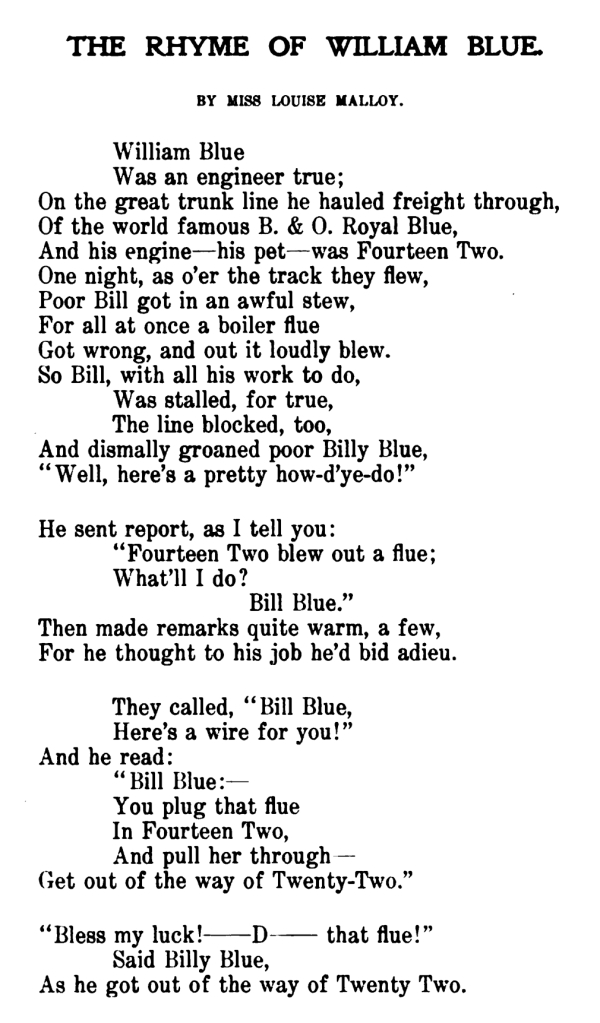
an engineer on the Baltimore & Ohio Railroad’s flagship, “Royal Blue,” as described in a poem in a trade magazine from 1899
Malloy, Louise. “The Rhyme of William Blue.” In “The Book of the Royal Blue,” published monthly by the passenger department of the Baltimore & Ohio Railroad, Baltimore, June 1899, p. 22.
Related
Soldier, sailor, av’rage guy
Imagine the frustration — in this day and age! — of knowing a song exists and not being able to hear it.
Playing the blues was “one of the very few means of self-support for blind African Americans” during the early 20th century, writes William Barlow in “Looking Up at Down: The Emergence of Blues Culture” (1989). “The labels knew they could sell more records by putting the word ‘blind’ before the artist’s name,” record collector John Tefteller told Goldmine in 2013. “… I don’t know if these singers really wanted to call themselves blind or not. Probably not.”
Most of the following musicians came from the Piedmont region except where noted. Send additions (with citations, please!) to zogernd [at] gmail [dot] com.
Blind Benny (Dallas.)
John William “Blind” Boone (Memphis, St. Louis; ragtime piano player. At 6 months old his eyes were surgically removed as a treatment for “brain fever.”)
Blind Ted aka Blind Pimp (Cincinnati pianist.)
John Henry “Big Boy” Arnold
Blind (Arthur) Blake (Born blind.)
Blind Bobby Bryant (Dallas.)
Blind Gary Davis (Blind since infancy because of glaucoma.)
Blind John Davis (Chicago pianist.)
Blind Willie Davis (Gospel blues performer originally from Mississippi.)
Simmie Dooley
Sleepy John Estes (Brownsville, Tennessee; lost sight in his right eye around age 11 after it was hit by a rock; went totally blind by 1950.)
Blind Boy Fuller (Went blind at 20 due to ulcers behind the eyes.)
Johnny Gatewood (Louisville pianist.)
Archie Jackson
Blind Lemon Jefferson (Born blind in Texas.)
Blind Willie Johnson aka Blind Texas Marlin (Blinded at 7 when his stepmother splashed lye water in his face.)




 Zögernd
