
Check out the first episode of the Zögernd podcast!
Chris Scanlon joins me to chat about Springsteen, prog rock, post-apartheid South Africa, and identity.
Watch on YouTube, or listen on Anchor or your favorite podcast app.
Check out the first episode of the Zögernd podcast!
Chris Scanlon joins me to chat about Springsteen, prog rock, post-apartheid South Africa, and identity.
Watch on YouTube, or listen on Anchor or your favorite podcast app.

After a cursory, thoroughly unscientific survey, I have concluded that one of the longest, weirdest chord progression in rock music is found in “His Kingly Cave” from Frank Black and the Catholics’ “Devil’s Workshop” (2002).
While certainly there are upward and downward deviations, the preponderance of rock and pop verses follow a three- or four-chord pattern spread over four, eight or 12 bars. (See, for example, virtually every Pixies song.)
In contrast, the verses of “His Kingly Cave” cram 14 chords (10 of them unique) into a 13-bar format. Exotic chords with weird fingerings, no less. Perfectly mystifying for a song about dropping acid at Graceland.
If “Cave” represents an extreme but successful aberration, what’s an example of an unsuccessful one? How many chords is too many? This is partly a question of what separates a rocker from a jazz douche. But really it’s a question of musical effectiveness. How far can you extend a progression before it becomes self-indulgent, unfollowable, unpleasant?
Here’s how the “Cave” verse is constructed and why I think it works:
The first eight bars conform to the G minor scale. Bar 9 (Fsus2 to F Major) is the gateway to another harmonic world. The final four bars revolve around the peculiar F Byzantine scale.
G minor and F Byzantine have three notes in common — F, A and C (Bb too, but that’s not important here). In other words, both can be used to build a plain vanilla F Major triad, which is what brings the progression to its conclusion and links it back to the more familiar ground of the first eight bars. So while the Byzantine scale’s sudden appearance seems to intensify the acid trip, it talks you back down just as quickly.
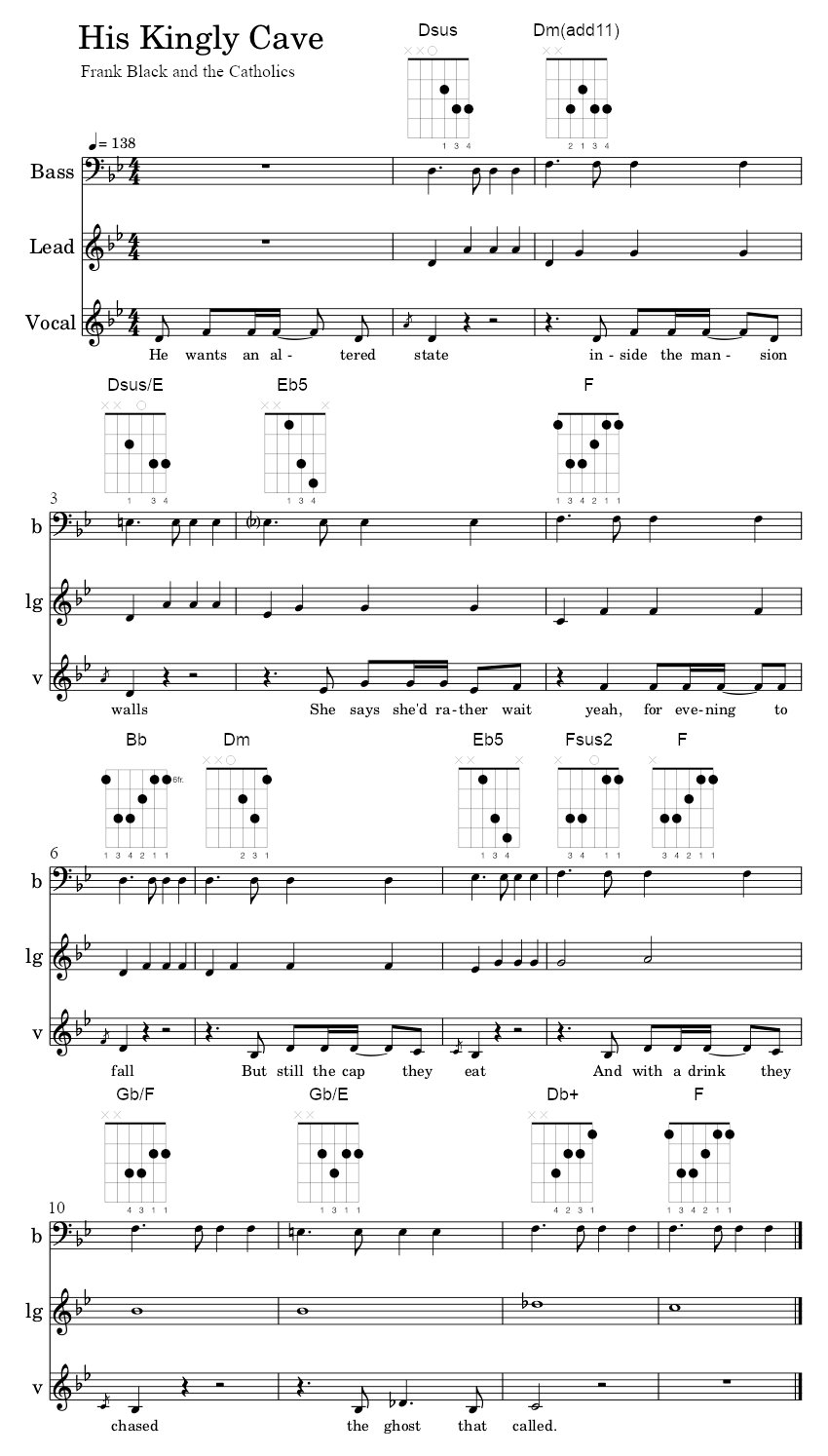
Exhibit A: Components of the verse of “His Kingly Cave.” Listen here.
Some other long chord progressions:
Coffee and TV – Blur
8 bars; 8 chords
B Am E(add9) E
G G/F Bb Db (2nd time: A)
Hallelujah – Leonard Cohen
16 bars; 16 chords, 5 unique
C Am C Am F G C G
C F G Am F G E Am
Jabberwocky – Daniel hales, and the frost heaves.
11.5 bars; 17 chords, 6 unique
Fm Cm Dm Ab
Fm Cm Dm Bb
Dm Bb Fm Cm
Dm Bb Dm Ab G
Blackbird – The Beatles
8 bars, 18 chords, 11 unique
G Am7 Bm(b6) G
C Em D F#m Em Eb
D Em C Cm Bm A7 D7sus G

Last week I proposed an experiment: To go a whole day without encountering music. It was destined to fail, but I knew the trying and the slipups would be interesting.
As it often does, the day began with the chirping of a chipmunk outside my open window. All one pitch and sort of a drunken swing rhythm, with occasional stutters shifting the pulse.
In the living room my daughter was watching her anime and singing along with a theme song that, unlike the dialog, was not dubbed into English. She sang the Japanese phonetically, approximately.
I went outside to read. Across the brook someone was listening to Top 40 radio. Elle King sang “they always wanna come but they never wanna leave,” and let me tell you I was scandalized!
At the transfer station, David Bowie’s “Changes” blared from a boombox. Last time I was there the attendant had been holding forth about the injustice of business closures and having to wear masks. This time he was silent. Perhaps he had decided to turn and face the strange.
The day before, I had recorded a podcast about Cocteau Twins’ “Heaven or Las Vegas” (stay tuned) and many of its songs shuffled in my brain throughout the day. The Human League’s “Don’t You Want Me” and Taylor Swift’s “Welcome to New York” popped in there too for a bit.
After dinner, unprompted, my daughter explained that the best way to get rid of a song stuck in your head is to repeatedly sing its ending. But the song stuck in her head was just a chorus, and she didn’t know how it ended. Her screen time was used up, and so she couldn’t seek it out on YouTube.
Took a walk. No headphones. Instead I tried to study the polyrhythm of my footsteps against the crickets against the bullfrogs against, from one backyard, Ja Rule’s inventory of Ashanti’s lips, smile, kiss, thighs.
Ended the day with a Zoom call where a friend mentioned Living Color’s “Cult of Personality.” Now the floodgates were open. A song I hadn’t thought of since the ’90s was suddenly the most important music ever. I cheated. I looked it up. It rocked.

What would our world be like without music? Quite a lot different, given that it’s everywhere now.
Even if you don’t seek out music, your life is soundtracked. It’s in advertising jingles and the breaks between stories on news radio. It’s playing over the loudspeakers at the grocery store, blaring from a passing car, on the phone when you’re on hold, when your computer starts up or your cellphone rings. Some washers and dryers even play a scrap of melody when you start them up.
Get away from technology and the man-made world and the birds are singing. Shut yourself in the quietest room in the world and, besides hearing the blood circulate through your earlobes, you’ll probably have a song stuck in your head.
Music is unavoidable. Which is why I’ve gotten curious about avoiding it.
The parameters of the experiment are simple: Don’t load a CD, don’t plug in the iPod, don’t turn on the radio. Avoid public buildings, elevators and dentists’ offices (pretty easy during this pandemic). Don’t pick up an instrument, and get out of the house when family members are practicing their instruments or playing video games. See if I can go 24 hours without hearing music from external sources.
Hearing it inside my own head will be inevitable, but I can deploy techniques to distract myself even from welcome mental music.
Will all this make my day duller? Will I, at the experiment’s conclusion, gorge myself on records like a starving person wolfs down food? Stay tuned to find out how successful my music cleanse is, and what if any conclusions I can draw from the experience.

You put on an old favorite record. It’s familiar and predictable and yet still full of wonder.
But what’s this? There’s a crack in the pleasure it gives. And growing up out of that crack is a tiny stem of guilt (shouldn’t you be discovering something else?). If you were to dig underneath, you’d find the roots have spread everywhere (shouldn’t you have discovered the essentials already?).
Here’s the ugly side of music enthusiasm: an abiding sense of failure. Of being in an unending or at least very long race in which it’s impossible to catch up to the other runners.
But the problem isn’t other music lovers. The problem is there’s too much music. And the worst part is that a lot of it’s probably pretty good.
New music is created at an exponential rate, with major labels, indie labels, everyone and their cousin’s local band producing supply that far, far, far exceeds demand and never expires. And wouldn’t you know it, the same turns out to be true for old music, with reissues and box sets conjuring every demo and alternate take, an infinity of previously unreleased riches.
While at some point decades ago it might have been possible to have a complete record collection, at least within your preferred genre, today you’d never have enough physical or digital storage space. You could permanently plug Spotify into one ear and Pandora into the other and never have time to listen to it all.
More to the point, absorbing and appreciating what you hear would be out of the question.
So completion is off the table. And no matter how dutifully you follow the recommendations of this or that cultural arbiter, becoming a well-rounded listener grows less and less possible with each passing beat. What’s left?

One day at the office, an arrow key on my keyboard got stuck. A colleague and I like to exchange music-themed puns, and he came in right on cue: “Who else is gonna bring you a broken arrow?”
And then the sentimental Rod Stewart hit from 1991 was stuck in both our heads. My colleague promptly left for a walk, saying he had to try and get it out.
Everybody dreads the earworm: the uncontrollable mental repetition of melodies or hooks or jingles or even rhythmic figures, usually ones that are unpleasant or annoying for the person having the experience. Having music stuck in one’s head is jokingly thought to lead to violence: “The only way I’m getting this song out of my head is with a bullet.”
The internet is chockablock with research around the causes of earworm and recommendations for getting rid of it. So I won’t bother positing any theories or offering any remedies. Instead I’ll offer a little sympathy for this musical devil.
Having an unwanted song stuck in your head is one thing. But for music you enjoy, it seems to me, the ideal is being familiar enough to conjure it in your mind without the aid of a recording. This of course takes repeated listening with careful attention to structure and texture. Not study, exactly, but something akin to it.
A while back I put on a jazz album that I hadn’t listened to in over a decade, and was surprised to find myself humming every solo, bass run, and drum fill, in much the same way some people recite dialog in unison with their favorite movie. I couldn’t automatically translate the sounds to an instrument or to staff paper, but they are written indelibly on my mind.
Earworms make an end run around one of your brain’s natural defenses, its tendency to forget. But when you’ve memorized a recording, you’ve intentionally earwormed yourself.

I claimed last time that I can’t help but give music my full attention. But that’s not completely true. When it comes to TV and movie soundtracks, I’m usually oblivious.
Sharper observers than me have described how filmmakers use music (or lack thereof) to help tell their story. Here I’m more interested in questions of the viewer’s bandwidth.
In my case, it may be that visuals and dialog just overwhelm my musical receptivity. Songs forefronted in montages and the music of musicals can’t well be ignored. But your standard dramatic orchestral score operates for me on an almost subliminal level. It’s more code than music. I’m getting context around the periphery rather than noticing notes.
I do become aware of the soundtrack, though, when it’s cloying. The protagonist confronts a heartrending dilemma, the strings swell, and that old Pavlovian lump forms in my throat. Music is supposed to communicate emotion, but movie music often feels like emotional manipulation.
There’s a whole world of film scores that don’t do this, and that, many will argue, stand on their own. Here’s one area where I’ve done practically no listening and that I feel ashamed about — but more on that later. For now, tell me how movie music operates on you, and send me your soundtrack recommendations.

It amazes me when I see co-workers sitting at their desks, typing away, with earbuds in. Doesn’t the music distract them from their work?
Or vice versa — doesn’t doing something else detract from the listening experience?
I usually can’t help but give music my full attention. Except for the most ambient music, I find I can’t concentrate on any other task (say, blog writing) if there’s music playing. As such I do most of my listening at times of relatively low CPU usage, so to speak, like when I’m driving or folding laundry.
But seldom do I listen to music to the exclusion of all other activity. That is, I don’t just sit in a chair and let a record play. My mind starts wandering. I need to be fidgeting with something or avoiding potholes. (Live music is different: You can watch the band, you can watch the crowd.)
Long ago I had a friend who would put on the TV, cue up a record and open a book. He also did a lot of Ritalin. His is an extreme case, but I’m interested in how far others are able to divide their attention when music is involved. Is being able to listen while doing other things an innate ability, or a habit that can be cultivated (or broken)?
If I’ve held your attention this far, tell me how it works for you.

Printed on 8.5×11 or scribbled on a napkin. Painstakingly constructed or thrown together at the last minute.
Musicians’ setlists fall into two basic categories that could be said to align with Freud’s concept of anal fixation.
They can be faithful pre-creations of a performance, or merely a jumping-off point. They may list actual song titles or the performers’ pet names for songs. They can get pretty involved as far as font selection and stage directions.
The truly professional or daring or carefree call out songs as they come to mind, no need for an agenda. But it can always be written down afterward.
The setlist’s Platonic ideal is the album track listing, which is an itemized receipt not only for rehearsal and preparation, but also the extermination of mistakes and awkward pauses.
For some musicians a setlist is a locus of anxiety. It’s a treasure map, but one that implies every unseen pitfall. A flight simulator that actually takes off.
Presumably it’s different for those on the expulsive side of the equation.
But all musicians crave validation; they may even settle for acknowledgement. If the gig is the service rendered, then the setlist is the documentation: an invoice, a timeslip, a W2. Redeem this coupon at checkout for half off obscurity.
 Zögernd