

The jam band Phish isn’t all jamming. A handful of their songs are rigorously composed from beginning to end, some following theme-and-variations frameworks worthy of any classical composer.
No member of this subset of Phish songs is more beautifully constructed or poignant than “Horn,” which the band has been playing live since 1990 and which appears on their 1993 studio album “Rift.”
It starts like a regular rock song, with a sturdy riff. Enigmatic backing vocals enter: “Rhine wine, car horn.” Then begins a verse about a toxic relationship:
Now that you’ve deceived me
and played my around
and hung those nasty flyers
on all the buildings in town,
dribbled my possessions
in a ring around the earth,
and bought and sold my self-control
for less than it was worth
The narrator seems to be working up to an assertive statement along the lines of, “It’s over.” But he doesn’t quite make it there. After more of the riff, he continues resignedly:
Now I know the reason
that I’m feeling so forlorn.
I’ll pick you up at 8 as usual.
Listen for my horn.
The horn is his car horn, confirmed by the backing vocals and imitated by the beep-beep double strum that ends each repeat of the riff. As an astute forum commenter points out, it’s probably also the horn of a cuckold. Could it be the vessel holding the Rhine wine, too?
If the lyrics are the narrator apostrophizing his perfidious lover, then the long instrumental passage that follows is his tortured inner monolog, where he cycles through several conflicting emotions on his way to pick her up.
The passage is built on two contrasting themes: We could label one the voice of sentimentality and the other the voice of skepticism. Both themes go through variations as the two voices within the protagonist challenge one another.
The first theme is itself made up of two shorter phrases, each conforming to the minor pentatonic scale. The first, sad and subdued, is an acknowledgement by our hero that he has been wronged.
Theme 1, Phrase 1.

The second phrase is brighter, revealing that the protagonist still holds out hope for the relationship.
Theme 1, Phrase 2.

The two melodic phrases combine into a theme that seems to say, “She done me wrong, but remember how good it used to be?”
What follows in Theme 2 is a word from the narrator’s own better judgment. This statement is blunt. While Theme 1 takes up more than eight measures, Theme 2 gets its point across in fewer than four. It seems to say, “Dude, time to move on.”
Theme 2.

The two themes go back and forth for 71 measures — or about two minutes, more than half the song’s total running time. In that space they are restated, expanded, modulated, reoriented. Most of all they gain in vehemence. Nearing the end, one gets the impression that the protagonist has screwed up his courage. But the long, sustained notes that conclude the instrumental seem to ask a simple, melancholic question: “why?”
Finally the riff and backing vocals return as an outro. What will our hero do when his lover gets in the car?
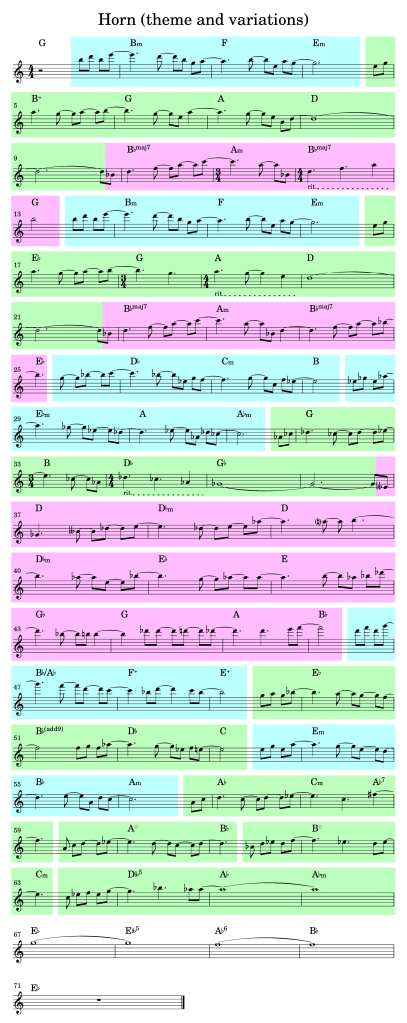
A note on the score: I’m indebted to Chris Emmerson, whose excellent guitar transcription made this project so much easier. I was on my own figuring out the piano chords, although MrSteevt provided clues. The accompaniment is built around a chromatic line that rises and falls (mostly falls) much like the protagonist’s spirits.
More theme and variations from Phish:
“My Friend, My Friend” (1993): 0:00-2:26
“Guelah Papyrus” (1990): 2:01-3:57
“All Things Reconsidered” (1993): the whole song
 Zögernd